Showing posts with label water. Show all posts

Sunday, January 7, 2018

Snow and Colors

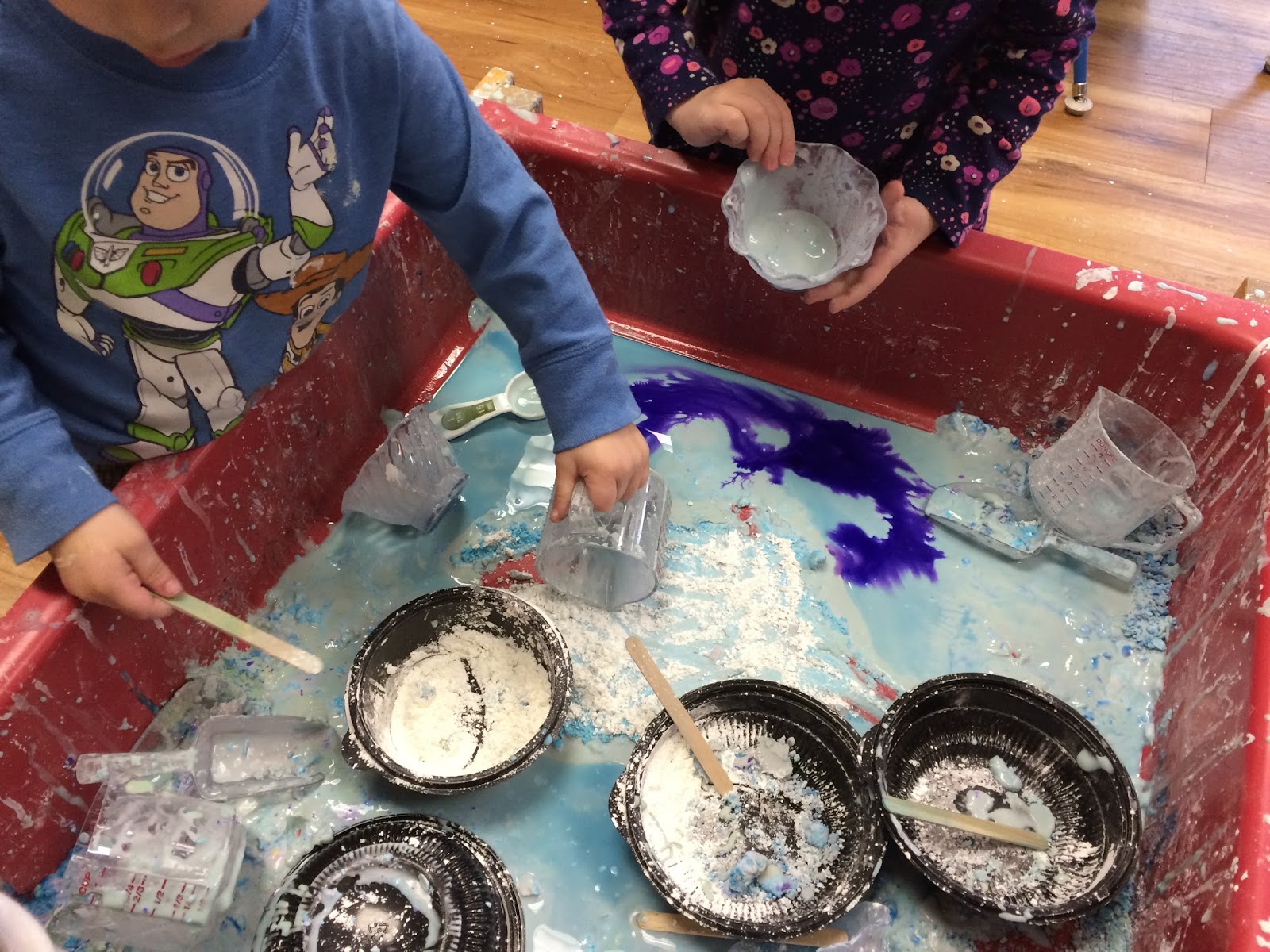
I filled the sensory table with snow, and set out small bowls of colored water. I handed children paintbrushes, thinking that they would paint the snow with the colored water.


It turned out that wasn’t what they were interested in at all.

Some of the children used the paintbrushes to stir or scoop up the snow, but otherwise abandoned them while they explored the more enticing items – the containers of colored water.


They poured the water from one container to the next, then dripped the water into a steady stream onto the white snow, watching as the colors spread. Once the water was all used up, they asked for more.


Seeing that the focus of the activity had changed, I quickly filled two small bins with colored water and put them on either side of the sensory table. The children raced to scoop out the water and pour it into colorful puddles in the snow.


Soon the snow was a multicolor patchwork, and later as it melted, a mass of brownish ice.


The next day, now that I knew what the children’s plans were for using the materials, I set up the area differently. I abandoned my idea of paintbrushes and provided craft sticks, which would be easier to stir the snow with. I added scoops that were easier to manipulate and pour from. And of course, bins of colored water at either end of the table, since the children had made it clear that pouring water and mixing were the most important aspects of this experience.


Through the morning the snow changed from white to yellow and blue, and eventually to shades of foamy sea green. Giving up my original idea in favor of following the children’s lead brought a whole new dimension to their play, in a beautiful way.


Monday, May 29, 2017

Loose Parts in the Sensory Table

For the past few weeks, I’ve been writing about ways to introduce loose parts in the classroom 
with the idea that intentional planning of the environment can help the children structure their play in a way that is both open ended for children and manageable for adults.

One area of the classroom that lends itself to loose parts play is the sensory table. Very often, sand and water play focus on the simple tasks of filling and dumping. These skills are developmentally appropriate, especially for younger children, but are also self-limiting, because once the skills of filling and dumping are achieved, what’s next? The tools that children are given to fill and dump water and sand also sometimes interfere with their play. Buckets and shovels that are suitable for a sandbox take up too much space in the table, and children’s broad motions of scooping often fling sand and water onto other children and the floor, frustrating teachers and leading them to limit this play, or to wonder whether sensory table play is really worth it.

Adding loose parts (beads, shells, buttons, rocks, animals, etc.) to the material in the sensory table can open a whole new dimension of sensory play as children hunt for hidden objects, sort and classify, and pretend. Adding containers and scoops that are small enough to handle easily without taking up too much room or spilling on the floor can help make this area more manageable for adults.


Loose parts in sand lead to digging, hiding and searching, sorting, classifying, counting, and patterning. Combining different loose parts with containers that are different sizes and shapes encourages mathematical thinking and experimentation.


Adding an additional surface inside the table (a small shelf, or a hollow block or plank) gives children the work space to arrange objects and fully carry out their ideas.


Loose parts in water also lead to sorting, classifying, and counting, with the added opportunities to explore scientific properties like sinking and floating. Adding containers such as toy boats, cups, or plates give more objects to compare and experiment with.


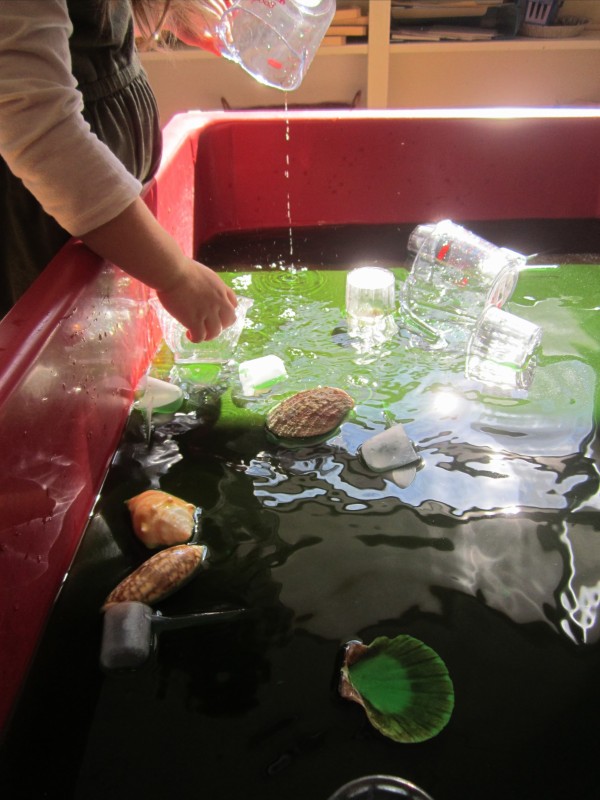
Dark water (colored with black or blue liquid watercolor paint) is great to hide objects in and search for them.


Or, the sensory table can be filled only with loose parts – pom poms, rocks, shells, napkin rings, beads, etc. with small containers and scoops, spoons, or tongs for filling and dumping.


The magic of loose parts is providing children with that spark of imagination, creativity, and problem solving to think “what will I do with this?” How do buttons in the sand change the experience of playing with sand? How does filling a tube with sand and counting bears differ than filling a cup with sand and beads? As you add and change the tools for children to use with the sensory material, and encourage the children to add and change the tools as well, their thinking and their explorations change too.

Sunday, February 21, 2016

Discoveries in Dark Water

I’ve always felt that sensory table play should have materials that suggest different purposeful things that children can do with them. Scooping, filling, and dumping is interesting at first, but once children master these skills and simple materials, they tend to get bored with water or sand play. Or, if they can’t easily find a goal oriented task with these materials, they sometimes create their own goals – which might not always be ones that the teacher is comfortable with.

 One material I like to add to water are objects that children can look for, sort, and gather. Any waterproof manipulatives that could be used on a table or other surface can be used in water. Coloring the water by adding watercolor paint provides a visual contrast, and if it’s dark enough, can provide the suggestion of hiding and finding objects in the water.


I colored the water a deep blue, and added large plastic buttons and counting bears. The colors provided a vivid contrast, and as an added bonus, the plastic buttons floated on the water.
The children gathered objects, sometimes naming the colors, or, in the case of the buttons, the shapes. Some tried to balance bears on floating buttons. One child noticed that blowing on the buttons pushed them across the water.


The next day I tried this with black water and different objects – thick poker chips and rocks. The children showed almost no interest in the rocks. The poker chips, like the large buttons, became objects to hide under the water, scoop out, and stack.


The conversation turned to how the different objects looked under the water, and what else we could hide in the water next time.

Tuesday, February 2, 2016

Cornstarch Goop: Wet and Dry and Wet Again

 After the explorations with frozen goop, I let the goop dry in the sensory table, and then gave the children the ingredients to mix a new batch of goop.


cornstarch

There’s no recipe, just cornstarch and water. I added liquid watercolor paint to the water, and placed the pitchers of water and bowls of cornstarch in the sensory table for the children to discover.


At the end of the day, it was time to leave the goop to dry out again. By the next day, it had dried into a thick, chalklike sheet, which crumbled easily into large and small pieces that could be scooped and spooned.


But, what is dry can be made wet again, so it was time for more pitchers of colored water.

Mixing cornstarch and water to make goop

Once everything was mixed together, it was too watery, so it I refilled the bowls of cornstarch.


And, once more, the mixture dried out again. All ready to be made wet again the next day.


Note: If you want to try this yourself, here are some tips. 1) If the goop is very wet at the end of the day, drain off excess water before leaving it to dry. 2) Be sure to leave the sensory table uncovered. If you have to cover it, use a light sheet and leave it vented on the sides so air can get through. 3) The drying process doesn’t work as well in humid weather. 4) If your goop starts to smell bad, or has black specks in it, it’s time to throw it out, sanitize the sensory table, and start again with a new batch.


Sunday, June 21, 2015

Color, Light, Shadow

I sometimes add liquid watercolor paint to the water in the sensory table just to change the visual appearance, but also because the colored water is easier for the children to see as they move it through clear containers and tubes.

One morning, as I filled the sensory table, the eastern light came in at a perfect angle and hit the water just so.


As the children played, the interaction of light and shadow on the colored water added a new dimension to their play. They moved containers and objects back and forth, between the light and the dark, observing changes in appearance.


Some children noticed the light reflected from the water in the table onto the ceiling, and watched as it moved across the ceiling during the morning.


“Look at the light!” “I see it!” “The water is shining!” The children can’t understand why the water is shining, or why the light shines in some places but not others. In fact, they weren’t even curious about why. But this simple moment of wonder in discovery, and opportunity to observe an event that it happens, is as important in the scientific process as the theoretical reasoning, predictions, and conclusions that will happen later.