Showing posts with label loose parts. Show all posts

Tuesday, May 7, 2019

When Talking Gets in the Way


It’s sometimes hard to know when to talk to a child who is deeply engaged in an activity, and it’s hard to know what to say. We’ve been trained as teachers to ask questions, comment, narrate, and reflect. There are times when the right question at the right time can extend a child’s thinking and provide the spark for the next phase of their activity.

There are other times when talking just gets in the way of what they’re doing.

Even as we say that “children learn through play” and that we value “process over product” so much of teacher speech interrupts the child’s process and trying to lead the child to a tangible product. Often when a teacher says, “Tell me about what you’re doing” or “What’s your plan?”, it’s less about meeting the child where they are in the moment, and more about the teacher wanting information for themselves. Or just wanting to connect with the child who is at play, which is a wonderful goal, but requiring children who are immersed in process to answer adult questions isn’t always the best way to connect.
  
I watched while one of the three-year-olds explored wood pieces and nuts and bolts. The wood pieces had holes drilled in them, with the intention that children would discover how to fit a bolt inside, and how to connect two or more pieces with a single bolt. She worked lining up the pieces, examining the shapes they were making. She put two pieces over each other, the holes lining up almost exactly.


“I wonder what would fit inside those holes?” I asked.

She completely ignored me, and I felt a sense of discontent, that I had encroached on her process. The bolts were right there – she had been using them a moment before. If she wanted to put a bolt in the hole, she would have. She didn’t need me to tell her how to do it. Prompting her to “fit something” inside the holes was about me and my need to “teach” – not about her need to explore the materials through her own process.

Later, she put in a bolt, but didn’t push it down to connect the pieces. This time, I stayed silent, and allowed her to experience the process her way, without my interruptions.

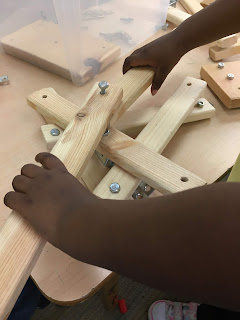
 She added more pieces, some with bolts, some without. I wondered if she had a plan, or was just seeing how the pieces worked together as she went along. But I didn’t say anything. Just because the teacher is wondering, doesn’t mean it’s useful to the child to be asked. My wondering about her plan should not take over her process. 


Eventually, after putting together many pieces, moving them around, and taking some apart, she announced, “It’s a clock!” and showed me how two of the wooden pieces moved like hands. She added small metal pieces and said they were the numbers. After observing her entire process, I don’t think she had a “plan” to build a clock, or to build anything. For young children, the representational “product” often comes at the end of the process. After completing the process of building, or drawing, or painting, the child decides what their creation looks like, and labels it. The true learning takes place in the process, and through the play of getting there. Sometimes there are questions or comments adults have that can help them in their process, but often, we just need to get out of the way.


Saturday, January 19, 2019

Themes and Loose Parts


I was thinking about the frequent questions I see from teachers asking what loose parts they could use for one theme or another. My perception of loose parts - or any play based curriculum - is that when the teachers determine a theme for the play, it takes some of the agency away from their play. Even when the theme comes from teacher’s observations of what the children are interested in, the planning sometimes becomes more about the teacher’s interpretation of the children’s activity than of the children’s activity itself. 


I once had a group of 3-year-olds in my classroom who kept playing "going to Hawaii". One of kids had been to Hawaii with their family that summer, and the idea originated with them. They would say "Let's go to Hawaii", and the kids would run around the block area, and then sit down. One child would announce, “It’s time for lunch”, and bring over objects that they pretended were food. When my co-teacher and I observed the kids "going to Hawaii" we this would be a great start to a travel theme. We brought in suitcases, tickets, and beach props, thinking the children would use the materials we were giving them to extend their play.

This all fell flat.


Once the children were surrounded by all the travel related props, they'd still yell, "Let's go to Hawaii", run around, and then sit down to pretend to eat. They weren't interested in pretending to be on an airplane or at the beach. They used the suitcases to fill with their pretend food, which they’d bring to the block area and spread out a picnic. After several days of observing the play, and talking with the child who was leading it, and their parents, we found out that for that particular child the most important part of their trip to Hawaii was the meal his family had the last day there, and that's what they were re-creating through play. Not packing suitcases, going to the airport, or playing at the beach. Their idea of "Hawaii" was sharing a meal with their family. The child’s concept of “Hawaii” was completely different than the one that the teachers were trying to create.


This is why it's so important for teachers to let go of our preconceptions about how to provide a theme for children, and for us to simply let them lead their own play. We can join in, following their lead, but in the end, the ideas are the children’s not ours.  And that's why loose parts are so amazing. A wood circle can be an airplane ticket, or a cookie, or a fish swimming at the beach. If we give children open ended objects that they can use creatively in whatever ways their ideas progress, then they don’t need us to provide props. And if they do need something more from us, or want us to collaborate with them in developing their ideas, they’ll let us know.


Wednesday, June 27, 2018

Where Do You Keep Your Loose Parts?


I see lots of posts on education discussion groups asking “Where do you keep your loose parts?” Or “What does your loose parts area look like?” In my classroom, I don’t have any specific area designated for “loose parts.” Loose parts are just another type of classroom material, which children are free to use where and how they want. However, I do put some on shelves in intentional ways, with the purpose of sparking the child to think “What can I do with this?” 

I set up a small table near the door to have some interesting materials, not necessarily as a provocation to play, but an invitation to come in the door. Entering the classroom in the morning and separating from parents and caregivers can be the most stressful part of a child’s day. Having material to explore as soon as you walk in the door can ease the transition.


Loose parts provocation with napkin rings and glass beads

I also have a shelf close to the door, but not too far away from tables, with loose parts, containers, and other materials, ready for children who want to explore but might not want to be right in the midst of the play area with other children.


The materials on the shelf are set up in a way to encourage children to think about different ways to use them together. A container asks “What will fit inside?” A tray of beads calls out “Touch me and see how I feel.” 


Sometimes the children choose to play with the materials right where they are.


Sometimes they take them to tables or other areas of the room.


The magic of this space isn’t about what the children will do in this area, or even with particular objects, but what ideas will be sparked, and where they will lead.


Sunday, March 4, 2018

The Point of Play


I spend a lot of time on online early childhood sites, reading blogs, commenting and discussing topics on Facebook groups, and scrolling through curriculum ideas on Pinterest. Over the past few years I’ve noticed a huge growing interest in things having to do with “Reggio Inspired” “Loose Parts” and “Nature Play”, which is really exciting to me as a teacher who has spent years encouraging children to come up with their own ideas, use materials the way they want and take the lead in deciding what they want to do and how they’re going to do it. At the heart of this is my core belief that children learn through play: through activities that focus on children’s process and that allow children to have control over the planning, decision making, and interactions during these activities.


But somehow, adults keep missing this.

It’s hard to be a “teacher”. I sometimes feel that title is like a heavy backpack of expectations each of us carries, never letting us forget that our “real job” is to be teaching children something. No matter how many times we say that “children learn through play” or “process is more important than product”, there’s that pesky “teacher” baggage weighing down and whispering in our ears that what we should really be doing is making sure the kids know their numbers and ABCs.


I see this over and over again in the conversations about classroom materials. The concept of using “loose parts” http://exploreinspireec.blogspot.com/2017/04/loose-parts-and-intentional-environments.html is about providing open-ended materials that can be used in many different ways, encouraging creativity, discovery, and exploration. There’s also attention to design elements, so many of these materials are truly beautiful, and their color, shape, and texture add to the overall environment of classroom space. But I’ve noticed more and more, adults getting caught up in simply having the materials to use for their own “teacher” purposes and less on letting children use them the way the children want to.


Every experience doesn’t need to involve an adult teaching an academic skill. Every time a child sits down with a pile of colored beads or blocks, they shouldn’t be expected to sort them or create patterns. Every time a child lines up a row of rocks, they shouldn’t be asked to count them. Teachers shouldn’t be focused on what the adults can make out of bottlecaps and rocks, they should be focused on creating an environment where the children will figure out what to do with them. Instead of spending time writing letters and numbers on tree circles and seashells, teachers should be embracing these materials for what they are – opportunities for children to be creative and expressive and the leaders of their own play. That’s what the materials are for – to play with. Not to find one more surface to write numbers and letters on, or to “teach” a concept or skill, but to create a space and opportunity for children to play. Play itself is the point of play.


Sunday, October 29, 2017

Purposeful Play and Loose Parts


I’ve had a lot of discussions with teachers who are enthused about introducing loose parts to their classroom, but then become frustrated that the children don’t “do” anything with them. Or, they’re frustrated with what the children decide to “do” with them – dump them all out, mix them all together, or other things that don’t match the teacher’s dream of engaged children arranging natural materials into beautiful designs.

Sometimes children dump and mix because they’re interested in dumping and mixing. Loose parts, especially small, uniform, loose parts, are an excellent sensory experience. Pouring, filling, emptying, and mixing are all natural actions for children. Younger children in particular might find pouring and filling to be more meaningful schemas than sorting and patterning. 


But sometimes children dump and mix because they don’t know what else to do with these materials. In the absence of any other cues, they turn to the familiar – dumping out containers, or mixing objects together to make soup, or ice cream, or some type of pretend food. When we’re introducing loose parts to children we need to think not only of the materials, but what we expect the children to do with the materials. We need to set up environments that encourage children to think “What can I do with this?”

Pomp poms in a basket by themselves suggest dumping. But paired with tongs and containers, they suggest lifting, grasping, and filling. Paired with trucks or dollhouses, they suggest filling, transporting, and pretending.


Containers with different size holes provide a physics experiment of what will fit through them.


Containers of different sizes, shapes, and dimensions challenge the children to explore spatial concepts and experiment with how pieces fit next to, inside, over, and under each other, as well as concepts of number, volume, length, and ratio. 


 Small containers and defined space can encourage sorting.


And, once the children start thinking “What can I do with this”, their explorations will lead the way.


Sunday, June 25, 2017

Loose Parts in the Housekeeping Area

I first introduced loose parts play into my three-year-old classroom five years ago. There were already loose parts in my classroom, but not that I had brought in with the specific intention of children using them in open ended ways for their own purposes. The science shelves had baskets of rocks, acorns, and shells with the intention that the children would experience “science” by studying these natural objects with the magnifying glasses and mirrors neatly arranged next to them. They rarely did. But what they did do was take out the rocks and shells, line them up, arrange them into circles and designs, fill bowls, bags, purses, and baskets, and carry them to other parts of the classroom, where most often, they turned into pretend food.

At the same time, my co-teacher and I noticed that there wasn’t much play in the housekeeping/kitchen area. Children went into the area, but didn’t seem to be pretending or even interacting with each other. They’d take out pieces of plastic food and hold a plastic apple or orange tightly in hand, or fiddle with the knobs on the pretend stove, but there wasn’t much social or complex play going on. We decided to see what would happen if we changed the materials: if we took out the plastic food that wasn’t eliciting play, and replaced it with the baskets of rocks, acorns, and tree circles that the children found so engaging. We added dried plants that gave the suggestion of food, but weren’t clearly representing familiar foods like the plastic playsets were.


Right away we noticed a difference. 

There children immediately began to spend more time in the housekeeping area, filling plates and cups and arranging materials on plates. 


The social play increased too, as the activity turned from picking up a single piece of plastic fruit to complex negotiations of passing baskets around, trading pieces, and passing out objects to each other. The rocks, acorns, and tree circles became ice cream, cookies, and soup. Conflict about sharing and turn taking disappeared, because there was so much of each item. Our plastic playset had only one or two of each kind of fruit, but we had a nearly limitless amount of pebbles and acorns that could be passed around so everyone could have some.


As loose parts play took hold in the classroom, the children’s play in every area transformed. Baskets of shells or wooden tree circles were no longer just for “science”. The children brought them to the housekeeping area, hid them in the sensory table, and added them to manipulative and block constructions. As time went by, and in following years, the housekeeping area became less a distinct place intended for pretend cooking, but more a just piece of furniture that looked like kitchen equipment, that was used to hold the rocks, glass beads, dried plants, pom poms, wood circles, and other objects that the children used in infinite ways of their own choosing. They often still used the loose parts as pretend food, but they felt free to use these materials in other ways as well, which is what I wanted as a teacher – not for children to use the materials the way I intended them, but for them to figure out – and act on - their own intentions.


For more about intentional planning for loose parts play:

Monday, May 29, 2017

Loose Parts in the Sensory Table

For the past few weeks, I’ve been writing about ways to introduce loose parts in the classroom 
with the idea that intentional planning of the environment can help the children structure their play in a way that is both open ended for children and manageable for adults.

One area of the classroom that lends itself to loose parts play is the sensory table. Very often, sand and water play focus on the simple tasks of filling and dumping. These skills are developmentally appropriate, especially for younger children, but are also self-limiting, because once the skills of filling and dumping are achieved, what’s next? The tools that children are given to fill and dump water and sand also sometimes interfere with their play. Buckets and shovels that are suitable for a sandbox take up too much space in the table, and children’s broad motions of scooping often fling sand and water onto other children and the floor, frustrating teachers and leading them to limit this play, or to wonder whether sensory table play is really worth it.

Adding loose parts (beads, shells, buttons, rocks, animals, etc.) to the material in the sensory table can open a whole new dimension of sensory play as children hunt for hidden objects, sort and classify, and pretend. Adding containers and scoops that are small enough to handle easily without taking up too much room or spilling on the floor can help make this area more manageable for adults.


Loose parts in sand lead to digging, hiding and searching, sorting, classifying, counting, and patterning. Combining different loose parts with containers that are different sizes and shapes encourages mathematical thinking and experimentation.


Adding an additional surface inside the table (a small shelf, or a hollow block or plank) gives children the work space to arrange objects and fully carry out their ideas.


Loose parts in water also lead to sorting, classifying, and counting, with the added opportunities to explore scientific properties like sinking and floating. Adding containers such as toy boats, cups, or plates give more objects to compare and experiment with.


Dark water (colored with black or blue liquid watercolor paint) is great to hide objects in and search for them.


Or, the sensory table can be filled only with loose parts – pom poms, rocks, shells, napkin rings, beads, etc. with small containers and scoops, spoons, or tongs for filling and dumping.


The magic of loose parts is providing children with that spark of imagination, creativity, and problem solving to think “what will I do with this?” How do buttons in the sand change the experience of playing with sand? How does filling a tube with sand and counting bears differ than filling a cup with sand and beads? As you add and change the tools for children to use with the sensory material, and encourage the children to add and change the tools as well, their thinking and their explorations change too.