Showing posts with label manipulatives. Show all posts

Sunday, October 29, 2017

Purposeful Play and Loose Parts


I’ve had a lot of discussions with teachers who are enthused about introducing loose parts to their classroom, but then become frustrated that the children don’t “do” anything with them. Or, they’re frustrated with what the children decide to “do” with them – dump them all out, mix them all together, or other things that don’t match the teacher’s dream of engaged children arranging natural materials into beautiful designs.

Sometimes children dump and mix because they’re interested in dumping and mixing. Loose parts, especially small, uniform, loose parts, are an excellent sensory experience. Pouring, filling, emptying, and mixing are all natural actions for children. Younger children in particular might find pouring and filling to be more meaningful schemas than sorting and patterning. 


But sometimes children dump and mix because they don’t know what else to do with these materials. In the absence of any other cues, they turn to the familiar – dumping out containers, or mixing objects together to make soup, or ice cream, or some type of pretend food. When we’re introducing loose parts to children we need to think not only of the materials, but what we expect the children to do with the materials. We need to set up environments that encourage children to think “What can I do with this?”

Pomp poms in a basket by themselves suggest dumping. But paired with tongs and containers, they suggest lifting, grasping, and filling. Paired with trucks or dollhouses, they suggest filling, transporting, and pretending.


Containers with different size holes provide a physics experiment of what will fit through them.


Containers of different sizes, shapes, and dimensions challenge the children to explore spatial concepts and experiment with how pieces fit next to, inside, over, and under each other, as well as concepts of number, volume, length, and ratio. 


 Small containers and defined space can encourage sorting.


And, once the children start thinking “What can I do with this”, their explorations will lead the way.


Wednesday, November 30, 2016

Loose Parts and Schemas: Enclosing and Transporting

I’m always fascinated by young children’s drive to fill and empty containers, and how a simple collection of containers and things to put inside can engage children endlessly, as they fill and dump, arrange and rearrange, and carry their collections from place to place. Teachers sometimes try to label these activities in curriculum terms like “sorting” “identifying” and “classifying”, but so often, what engages the children is the simple act of combining materials together and exploring the relationship between empty spaces and objects, between containers and what can fill them.


 One way to describe this play is through schemas. Enclosure (putting objects in containers, or creating containers for objects) and transporting (moving objects from place to place) are more than simple motions. They’re the ways that children experience and create understandings about the world around them.

I watched this play develop in my two-year-old classroom recently, first as children began to scoop loose parts from large baskets into smaller cups and bowls.


First, the movement was from one basket to one bowl, but soon, they lined up rows of containers, distributing rocks, shells, and poker chips into all. They weren’t interested in sorting or counting, just moving the objects from one container to others.


 Next, they sought out containers with tops to fill just slightly or to the brim.


And carried objects to different areas, seeking out anything that could be used as a container.


I don’t know what the children’s criteria were for choosing materials, or deciding where to put them. I don’t know what connections were being formed in their heads, and I couldn’t label the specific“science” or “math” or even “problem solving” skills that would satisfy a prescribed list of early learning standards. But anyone could watch these children at play and see without a doubt that they were engaged, they were curious, and that they were processing the environment around them. This is how meaningful learning takes place.


Sunday, June 26, 2016

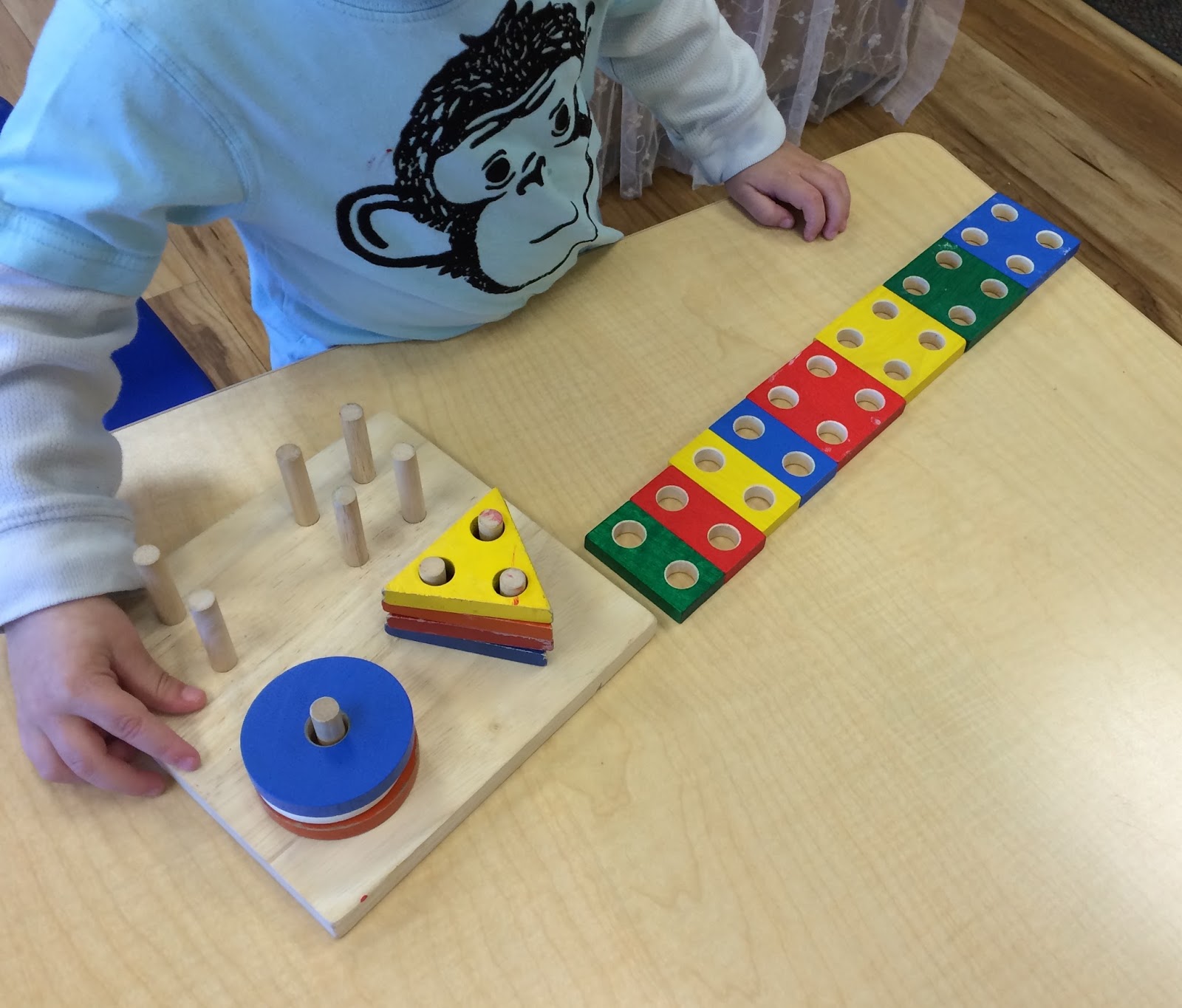
Playing Their Way – Geometric Shape Sorters

All of us – children, teachers, parents – have some toys we like more than others. I’m personally not a huge fan of math manipulatives that involve sorting for the sake of sorting, or fitting pieces together for the sake of fitting them together. I’m a lot more interested in manipulatives that can be used for creative building, or that can be used in a variety of ways – not the “self correcting” way where if a child doesn’t do what the toy designer planned, they can’t complete the task.

But, materials speak to everyone a variety of ways, so even if a toy isn’t one of my personal favorites, I still have it in my classroom, because one of the children might find it interesting even if I don’t. There’s also the tricky balance of selecting materials that meet the needs of all the children – ones that are challenging enough for older children but not frustrating for younger ones. One of things that’s appealing about open ended and “found” materials is that children can use them in a variety of ways, at whatever developmental level a child is at.

But, even if a toy seems to be close ended, giving children the freedom to explore and find novel ways to use that toy encourages innovation and problem solving. I saw this as my two-and-three year olds explored “Geometric Sorting Boards”. These are puzzle like contraptions that have multi-colored geometric tiles that fit onto pegs. Each geometric shape has a different number of holes, with the presumed goal that the children will line up the correct tile over the correct pegs. According to the manufacturer, this toy teaches “math concepts” “shape recognition” “color and pattern recognition” and “early geometry”. What I notice more often is that this toy is frustrating, because it’s hard to line the holes up over the pegs. And most preschool age children aren’t developmentally able to consider multiple characteristics of an object simultaneously – color, shape, number of holes, number of holes, and most of all, considering number of holes and number of tiles at the same time.


So, what did young preschoolers do with the geometric shape boards?


They took the shapes off the pegs. They stacked the shapes and lined them up. They carried the shapes to other parts of the room and pretended that the circles were cookies.
A few children tried to fit the shapes back on the pegs, but quickly lost interest. The pegs weren’t as interesting as the shapes themselves.


As I wrote in my last post, children will play their way with whatever we give them. We don’t need to “teach” children colors, geometry, and number – those concepts are embedded in the objects all around them. And trying to “teach” a concept they aren’t interested in isn’t going to work. Real learning takes place through self-initiation, exploration, and innovation.

Wednesday, May 25, 2016

Just One Small Planning Decision

I write a lot about intentional teaching, and the importance of setting up activities in a planned and thoughtful way, but there are always those “why didn’t I think of that before” moments.
One of the manipulatives I have in my classroom are “hex boards”. I don’t know what this toy is actually called, but it’s a set of boards that have rows of raised circles along with multi-colored hexagon shaped tiles that fit on top. I assume they were designed for patterning activities. Sometimes the older preschoolers use the boards this way, lining up rows of different colors, or choosing to alternate tiles in a pattern. The younger children usually just fill up the boards in a random way, with the goal being more about filling it up than about selecting colors. Sometimes they try to choose specific colors, but get frustrated digging through all the tiles trying to find just the blue or just the white ones.


Usually I set up the boards on a table with individual containers of tiles, so each child has their own materials. But one of the problems is setting up this activity so each child has enough tiles to fill their board. The boards take up a lot of space, and so do the containers. Now that we’ve reached the point in the year where they children are more comfortable sharing materials, I thought I’d try putting the tiles in a container in the middle of the table.

At first I was going to put them in a shallow basket, but then I noticed a divided container that I usually use for playdough toys or art materials. Seeing the five sections, I wondered what would happen if I sorted the tiles by color.


Of course, their play was immediately more intentional. Some of the children always showed preference for certain colors, but the tasks of simultaneously sorting and arranging were too much. Now that the tiles were neatly arranged into color groups, most of the children could concentrate on choosing the colors they wanted.


At first they each chose a single color and created relatively monochromatic designs.

But as they worked longer, they began to combine different colors. No one made patterns or representational designs, but there was a clear intention in the children’s work, as they chose materials, instead of simply picking up whatever was in reach and randomly putting it down. The arrangement and presentation of the materials matter. One small decision by a teacher to set up the materials in a slightly different way changed how the children were able to use the materials.

Just like many of us would rather choose which pen to write with than randomly reach into a drawer and take the first one we find, children also want – and need – the opportunity to choose, plan, and make decisions about their own work.