Showing posts with label social play. Show all posts

Sunday, December 5, 2021

Letting Play Evolve

I've heard so many comments from teachers worrying about children "making a mess", or teachers insisting that children put away one toy before taking out another. Children's play isn't divided into distinct parts. Children don't take out one toy, or one group of objects, stop playing, then put it away to begin anew with something different. Play is fluid and evolving and continues over time. Putting away materials in the middle of playtime stops the possibility of the child returning to and continuing their play, and stops opportunities for other children to extend on another's idea. Leaving the materials out for the entirety of playtime allows play to evolve and collaboration to happen.

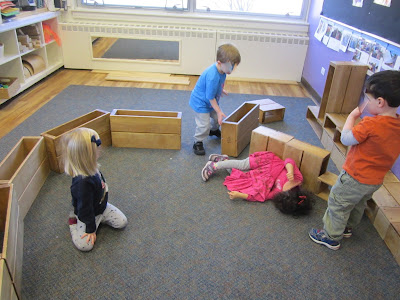
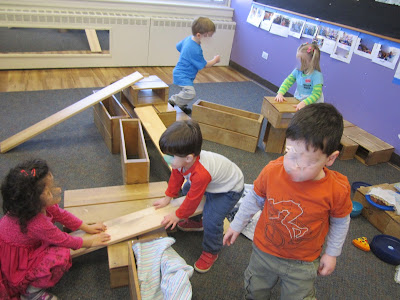
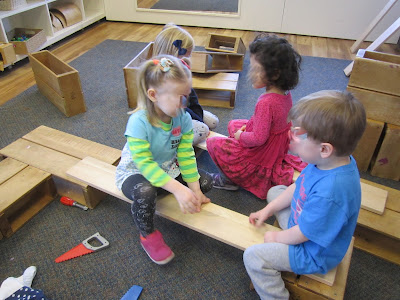
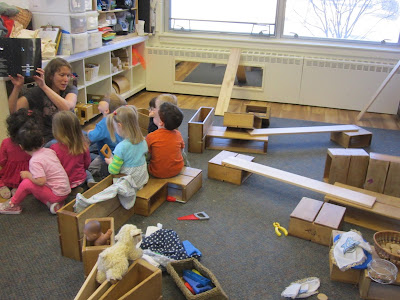
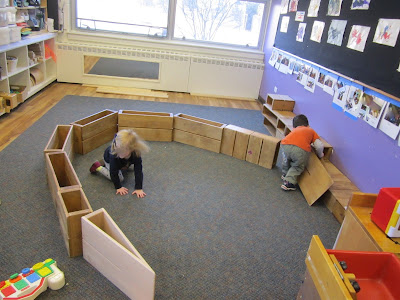
Here is a series of pre-pandemic photos from one morning in my 2-3 year old classroom:

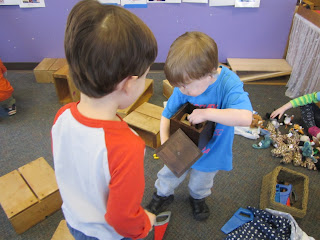
Early in the morning, two children took out the big blocks and built a large enclosure.


A few more children arrived, and began to take it apart.


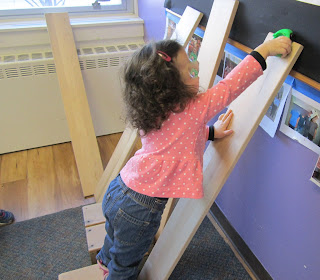
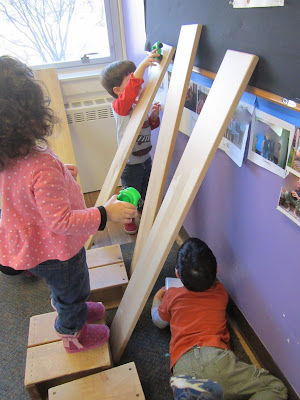
This launched a flurry of building, as the children rearranged the blocks into a new structure, and added all the remaining large blocks. Soon they discovered that the wooden planks made excellent see-saws and bridges.


After a while, a child brought me a book and asked me to read it. The block builders were interested and came over to hear the story. Their block structures stayed where they were, ready for children to return. Some of the blocks turned into seats.


While the builders took a story break, the block area quieted down. A child who had avoided the large group commotion earlier in the morning came over to explore using the large planks as ramps. Soon, some of the original builders returned and joined her.


The block building projects was mostly over as the children moved to other areas of the room, or brought other materials to the rug. Some of the children stayed by the blocks, using them as seats or walking from block to block. One child filled a box with small toys that other children had left on the rug and walked between the blocks, handing them out.


Soon, the morning playtime was over, and it was time to clean up and put away the toys. The children and teachers worked together, putting toys back into baskets and stacking the blocks against the wall all ready to play another day.


Friday, April 27, 2018

All The Blocks


“But they’ll take out all the blocks.”


Yes, they sometimes will. Sometimes they’ll take out all the big blocks, and then the little ones. And the animals, and the cars. Sometimes they’ll fit the little blocks inside of the big ones, and line up animals and cars in every empty space they see. 


That’s what the blocks are there for. That’s what all the toys are there for – for the children to use, to play with and to bring their ideas to reality.


I’ve always wondered about teachers’ hesitancy to let children play with all of something.  Teachers choose to limit children’s block play for so many reasons – concerns about safety, about activity level, about sharing. The limits are usually less about the children’s abilities than about the teacher’s feelings of control. And sometimes having all the blocks being used at once seems overwhelming to teachers, as teachers imagine every possible scenario of what could go wrong. Will the children really clean them up? How much space are they using? What happens if they get knocked down?


But instead of worrying about what could go wrong, take moment to consider what is going right.


Yes, they’ll take out all the blocks. And they’ll work together to build some amazing structures. They’ll add details and figure out mathematical relationships and engineering concepts that they can visualize years before they can explain them. They’ll create a space that is theirs. They feel a sense of ownership and pride as they develop the setting for their play, and create something that has the awesome grandness of being big and complicated. They’ll take out all the blocks, and it can be wonderful.


Thursday, January 11, 2018

Making Space For Blocks

I’ve written before about the mixed feelings some teachers have about block play – especially “big blocks.” They worry about safety, or about the play “getting out of control.” They aren’t comfortable with active play indoors, or with the themes that large block building evokes, like spaceships and superhero hideaways. They want to avoid the inevitable social conflict that comes as children discuss, collaborate, and sometimes argue about what they’re going to build. 

Block play is messy and complicated - but it needs to be. Children need the experience of lifting, moving, stacking and arranging these heavy objects into something that they've planned and designed. They need to plan, discuss, argue and negoiate their ideas with each other. They need the freedom to carry out their ideas and enact pretend themes - including superheroes and alients. And they need to feel the power, self-fulfillment, and personal efficacy of the simple grandness of block construction - the power of building something bigger than themselves.. The same innate drive that led ancient humans to build towers of rocks and stone draws children to build - higher, wider, and bigger, to create something that in its sheer scope, suggests power and a feeling of "wow, look what I made!"


And, this grandness takes space.

When we make decisions about how to use the space we have, we can make a decision to create space that will allow these block constructions to happen.

It might be a large space, big enough for several groups of children to each build their own structure.


 It might be a small space, where children are given the freedom to fill that space with their block creation.


It might not be a particular space at all, but a flexibility on the part of the teacher to allow block building to happen wherever it is that the children find a way to make room.


 And wherever it happens, when we make space for blocks, we’ve made space for children to express their competency, their power, their imagination, and all of the skills and development that comes with.


Wednesday, December 7, 2016

One Size Lesson Does Not Fit All

After observing how engaged my two-year-olds were while filling containers and exploring the concepts of empty space and fullness, I decided to introduce some other materials that involved filling spaces.

I set up a pegboard and pipe cleaner activity that a previous group of two-year-olds had used extensively, lacing the pipe cleaners through the holes, passing them back and forth through front and back of the board, working intently both alone and alongside others. I thought the children in my current class would have the same experience.


Several children did put the pipe cleaners through the holes. One child even laughed happily each time he pushed a pipe cleaner through and it disappeared as it fell through the hole. But within minutes, the pegboards were forgotten, and the activity turned to gathering up the pipe cleaners, each child grabbing for as many as they could hold.


My attempts to redirect the children to the pegboards were completely ignored, as the game became to pick up as many pipe cleaners as possible and hold them tightly so no one else could take them.

Then I said to one of the children, “I don’t have any. Could you please share some with me?” She handed me one, to which I said, “Thank you.” Then I pointed out another child who didn’t have any. Could she give some to her? She did, and that child smiled and said, “Thank you.”


Soon the gatherers were handing pipe cleaners to each other, exclaiming, “Thank you!” and then laughing as they handed them back for a “Thank you!” in return. The pegboards and filling activity was completely forgotten (not that there was a lot of interest to begin with). Their play was about passing materials back and forth, not about filling holes or fine motor development or any of the tasks I had considered.


While I was a little disappointed, I wasn’t surprised. The original pegboard activity that was so enticing had been planned based on observations of those children’s activities. Not just on my guesses of what they might be interested in, but by introducing materials for play that they had shown interest in before. Those children weren’t just interested in the concept of filling holes, they had helped teachers hang curtains on pegboards, and came up with the idea of threading pipe cleaners through holes on their own. Their participation in the planning of the activity (even if they didn’t realize it), is what made it interesting to them. But another group of children, with a different set of interests and experiences, focused on another aspect of the activity, simply gathering the pipe cleaners into bunches and passing them to each other. 

As teachers, we’re so often pulled in by Pinterest pages and curriculum guides that show us perfect activities for every concept, every theme, and every topic. Sometimes those activities are just as interesting to the kids as we hoped they’d be, and sometimes, they inexplicably fall flat. The best teaching is an interaction between what we as teachers know, and how children see the world. There is no one activity, no one size fits all curriculum plan that will work for every child or every class. Our job is figuring out what fits.


Wednesday, April 27, 2016

It's Just Playing

Even in play based programs, sometimes it feels like the children should be doing more than “just playing.” Recently I read an excellent post on the Happiness Is Here blog titled “Why I Don’t Like Play Based Learning.” The author talked about how the term “play based” is often used to describe adult led activity, instead of genuine child-led play, which she describes play as: “self chosen, enjoyable, inherently valuable, and unstructured.” In a child focused view of "play based" the emphasis should be on the process of play, not the product.

One of the key aspects of true play based learning is the opportunity for children to engage in social interaction and negotiation, and to have opportunities to develop self-regulation, planning and other skills that we often refer to as “executive functioning”. Teachers sometimes have a hard time noticing that these skills are being used and practiced, because their development isn’t as obvious as a discrete academic skill. It’s easy to see a child sorting blocks by size, it’s a lot harder to see a child using non-verbal cues to negotiate a place to sit on a block structure. And much of what is learned through “just playing” can’t be quantified or classified. It’s the experience and the process itself through which the learning happens.

I see this happen every day in my classroom, most often in the “block area”, which isn’t a block area so much as an area that, among many other things, happens to have blocks in it. The main attraction of this space is its space – a large rug where there’s room to build with large blocks, spread out rows or piles of loose parts, or to just move around.

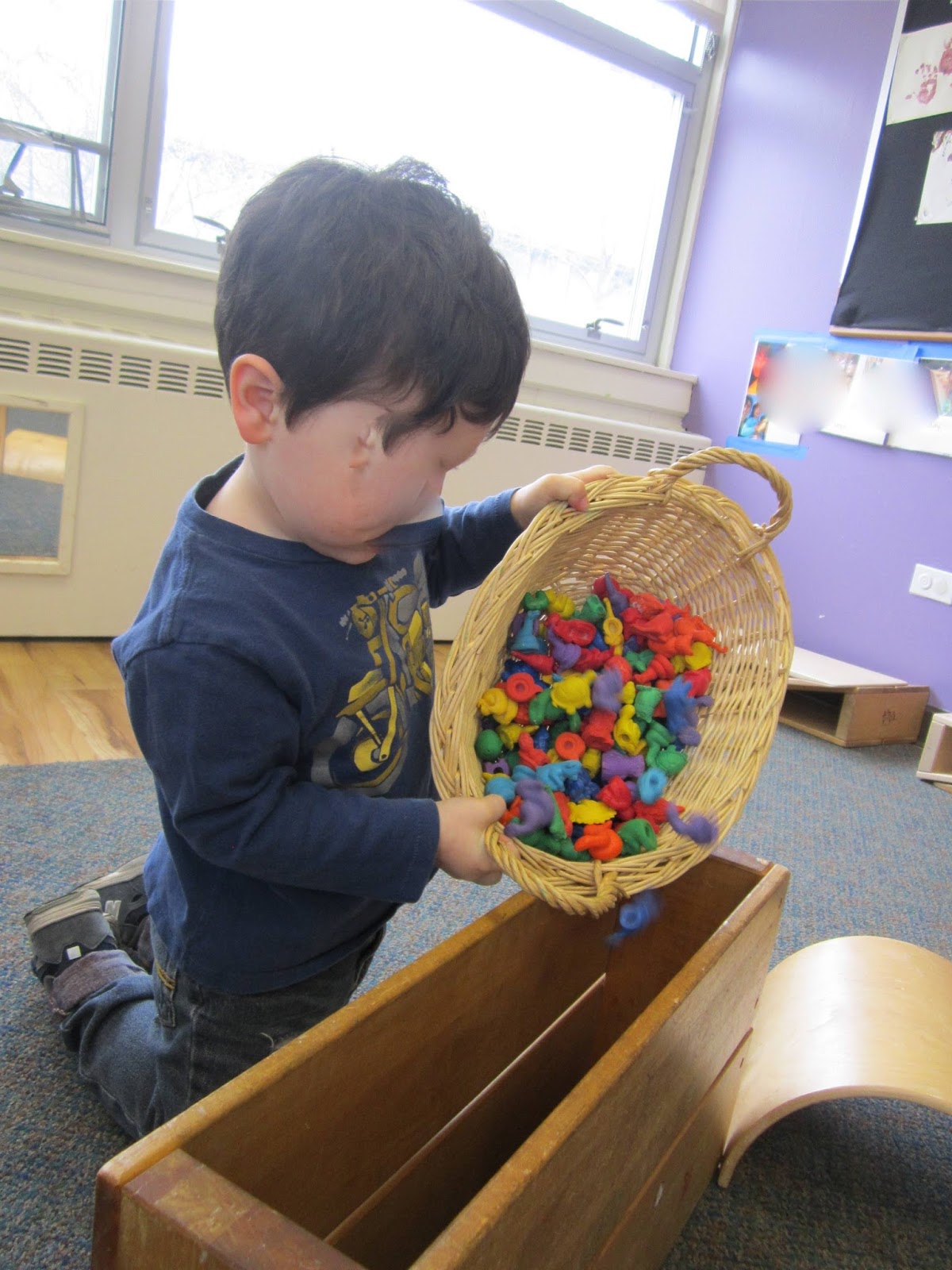
The other day, one of the children carried a basket full of small plastic animals over to a large hollow block that was balanced on its side, and slowly poured the animals into it. This soon attracted a larger crowd, as children huddled around to peer into the colorful pool of animals.


“I think I can reach it”, someone said, and put their hand in to pull out just one piece. Then the next person had to try it, as they each took a turn reaching into the block and excitedly examining the animal in their grasp.


I think it needs to be higher,” one of the children said, and another came quickly to join him in lifting a block onto the first block. Looking at the two-story block, the builders attempted to reach in and discovered that it was too high, so they took down the block.


Their audience remained huddled around the animal filled block, gazing inside. Suddenly one child sat down and swung her foot into the hollow space. “I think I fit in here,” she said. The conversation turned to who wanted to try putting their foot into the space to see if it would fit.


Meanwhile, around them, construction had begun. Turning their attention away from the block that a foot could fit into, the children who had started the structure joined in with the construction crew who had just joined them.


Eventually, they all left their building and pushed some blocks back against the wall. They sat on them, and stood on them, and smiled and laughed at each other as they lay down and slid down slanted blocks to the bottom.


I wouldn’t have been able to observe their play and document skills by marking them off on a checklist. Maybe if I was pushed to describe what they were learning I’d say something about spatial skills and cognitive reasoning. But the real learning was in their ongoing interactions as they were “just playing” – from reaching into the blocks and sticking their feet inside, to sitting and relaxing while smiling and giggling. There’s no way we as teachers can force that learning to occur. We just need to create spaces where it can just happen.

Tuesday, April 5, 2016

Getting Out of Their Way

One of the interesting features of full day programs is that there are often times at the beginning and the end of the day when there are only a few children in the room. It’s a perfect time for child directed play. But sometimes during these parts in the day, I wonder what I should be doing while the children play. There’s plenty of child directed play going on during other parts of the day too. But when all the children are at school and the class is spread across the room involved in half a dozen different activities, it’s rare for teachers to have a moment to step back at all. While some of the children might be able and even happy to sustain their own play without teacher involvement, chances are some of the rest will either need or want a teacher playing with or working alongside them. But when it’s only two or three children, deeply engaged in a world they’ve created for themselves, what should the teacher do?

I watched as one child lined up blocks and the other brought over a picnic basket. “Do you want some cookies?” he asked, opening the basket. The block builder accepted a cookie, and then pulled out a stuffed cat from a nearby basket. “But the kitty’s in the middle. The kitty’s gonna come out.” Soon the picnic was being shared by three stuffed cats.


“Here come the zombies,” one of the children announced. “Let’s pretend the kitties are scared. They can also fly. These are like jet packs.” They flew their kitties flew around the room for a bit, then sat down on the couch. And then the conversation took a more somber turn.

“Let’s pretend the mom died. And this kitty is dead. He’s dead. But not really.”


Out of the corner of my eye, I saw the child with the dead kitty look at me slightly, and turn away quickly when my eyes almost met his. I stepped back and turned away, pretending to straighten some paper on the shelves. He pointed to the other cat. “This one is also sad right now because he wanted his mom.”

His friend looked at him thoughtfully, then, carrying the cat, went over to a basket and brought back some snap together gears, reaching out to hand them to him. “But he’s going to find him some toys. It’s a three wheel toy. It’s called a monster car.”


They sat and fiddled with the gears, holding the cats in their laps. They moved the gears around back and forth. There was little conversation, and no invitation for me to join in. I watched, as quiet as they were.

Then the second child, who had brought over a monster car for the sad cat who was missing his mom, spoke up. 

“Is this the mom? Because I’m going to get her back alive.” He carried the cat to the sand table and placed her inside, moving her back and forth in the sand. “I’m going to put her in here because it’s a safe place.”


He glanced sideways at me, then shyly smiled, as if suddenly aware that they were being watched. The two children looked at each other, then at me, and dropped their cats and went to play with something else. Quiet as I was, my presence broke into the world of pretense where dead mommy cats can be brought back to life. And what if I had spoken earlier or had tried to bring myself into their play instead of trying to not intrude?  Would the spell have been broken sooner?

Even harder than teaching is not teaching. Sitting and doing nothing – not even making eye contact – seems the opposite of teaching. But sometimes that’s what children need. Not direction, suggestion, or facilitation, but the teacher being there just in case she’s needed. And if she’s not needed, getting out of the way of their play. I’m reminded of Waldorf teachers sitting in rocking chairs absorbed in handwork, being present but not intrusive, as the world of the child’s mind unfolds around them. Sometimes the best way we can teach is simply by getting out of the way.
Thursday, July 16, 2015

Playing With The Rules

In the four-year-old room, several children were using the “hex tiles” – small colored plastic tiles that were originally part of a patterning set, but that the children use mostly as “loose parts”. They sometimes pretend the tiles are food or money, they use them to build and stack, and they often simply arrange them in colorful designs without the constraint of the patterning trays.

Today, that seemed to their activity. After they dumped the basket of tiles onto the rug, they began constructing a winding, curvy line of tiles. Then one of the children brought over a basket of rubber animals – monochromatic, brightly colored animals that were probably designed as counters or math manipulatives. As one child placed tile next to tile, another started to put one animal onto each tile.

Would she match colors? Make patterns?


She announced, “Green on yellow”, and placed a green bear on a yellow tile. Then, “Red on orange”, putting a red frog on an orange tile. “Yellow on yellow.” “Blue on pink”. While one child continued laying out the tiles, first in a line, then in a rectangle, then in an ever growing spread, the other announced the color combination she was creating as she placed each animal on a tile. Eventually, the first child stopped placing tiles and joined her partner. They alternated turns as each child said her color and placed an animal.


Looking at the array of tiles and animals, there was no pattern, no matching, in fact, it seemed like a random arrangement of pieces pushed together into a large group. But having watched the children’s process, it was clear this wasn’t random at all. Working together, two children had devised a game with rules – not the rules of color matching that a teacher would have come up with, but rules nonetheless, as they established a system of placing tiles, pairing a tile with an animal, and announcing their action out loud. And then pausing, so the other child could take her turn.


They weren’t playing a game with rules, they were playing with the rules. They were constructing a concept of what rules are, and inventing a game with very beginning, rudimentary rules. They were playing with and exploring the concept of having rules, and order, and turn taking – all within their control, as they figured out what the rules were, and how the rules worked.