I've heard so many comments from teachers worrying about children "making a mess", or teachers insisting that children put away one toy before taking out another. Children's play isn't divided into distinct parts. Children don't take out one toy, or one group of objects, stop playing, then put it away to begin anew with something different. Play is fluid and evolving and continues over time. Putting away materials in the middle of playtime stops the possibility of the child returning to and continuing their play, and stops opportunities for other children to extend on another's idea. Leaving the materials out for the entirety of playtime allows play to evolve and collaboration to happen.
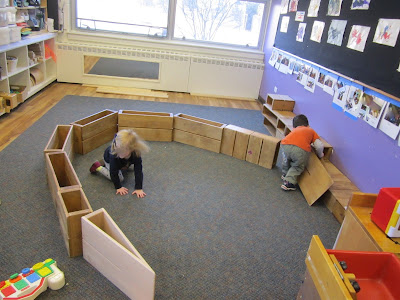
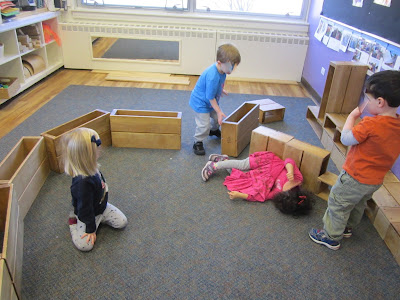
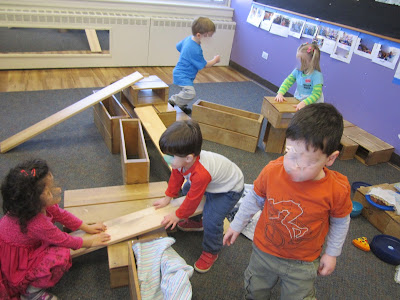
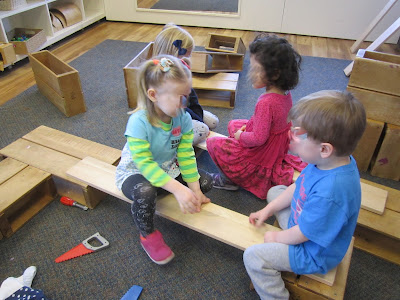
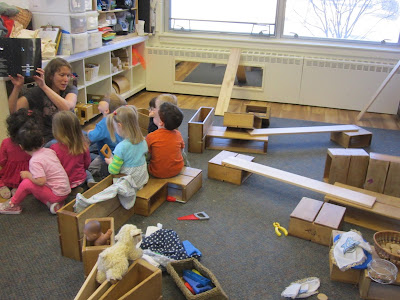
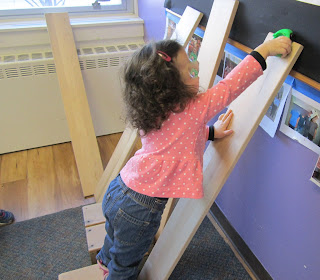
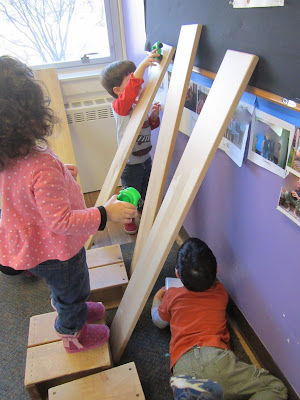
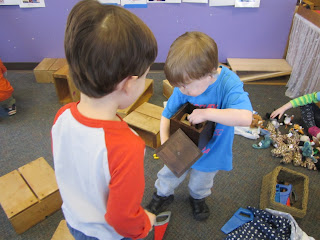
Here is a series of pre-pandemic photos from one morning in my 2-3 year old classroom:
Early in the morning, two children took out the big blocks and built a large enclosure.
Sunday, December 5, 2021
Letting Play Evolve
Sunday, August 9, 2020
Making Room For Play 2020
Like many other preschool educators, I’ve spent these past months wondering and
worrying about what preschool will look like when we reopen. How do we maintain
the essence of early childhood education - children socially interacting and
playing with each other – while trying to maintain some physical distance between
children?
There isn’t an easy answer, and what teachers and
schools will be able to do will vary widely, depending on local regulations,
resources, community values, and school philosophies. As I’m thinking about how
to set up classrooms in a way that inspires play but encourages children to
keep some distance from each other, I realize this isn’t completely different
than things I’ve done before.
The key to setting up a classroom environment is intentional planning - using the physical environment as a “third teacher” to help guide, inspire,
and provoke learning. How we arrange furniture, materials, and toys influences
how children will interact with that space and those objects. Sometimes that
planning has involved ways to encourage children to space themselves out in the
classroom, and make room for play.
In the past, my planning focused on ways to reduce children’s conflict and
stress so that they could work and play constructively while building relationships,
and eventually be ready to share space and play cooperatively with peers. Now there are new reasons to give children
more room to play, but the strategies are still the same.
Often teachers plan a single focal activity for the
day – an art project, science experiment, or sensory experience that’s so
engaging that everyone wants to do it right away! Or teachers put out the new
manipulative or fresh batch of playdough and the entire class runs excitedly to
play with it. Instead of having a single attractive activity, multiple
interesting activities spaced away from each other can help children naturally
move apart from each other. If the brand new magnet tiles are on one end of the
room, and the fresh playdough is on the other, it’s easier for the children to
spread out and not play in the same space.
2. Define space
Some of my favorite teaching tools are individual trays
and bins. So much of children’s time in school is spent defending their space and materials from other children. For some children, worrying about someone taking their toy can become so
paralyzing that they can’t relax and play. Trays and individual work stations
define space, so that children can feel a sense of ownership, but can also be
set up to physically space children apart from each other.
3. Provide multiples of materials
As an adult, you wouldn’t want to have to share a pen
with someone else to take notes at a meeting. But we often set up this
situation for children – a child wanting to paint a rainbow needs to wait until
another child is done with the purple before putting on the final stripe. Having
enough materials means children can stay focused on their play, and feel secure
that they will have what they need. Having duplicate materials in individual
work space also limits the need for passing and sharing objects that might also spread germs.
4. Loose parts
Providing multiples of materials can be challenging. For store-bought materials, it might not be possible to have enough to set up individual spaces. Loose parts especially found and recyclable materials can be an easy way to split up materials. Bottle caps, rocks, sticks, shells, and beads are things there are many of. Sticks, leaves, pebbles, and other natural materials have the added benefit of being renewable – after play, they don’t need to be cleaned, you can just put them back outside and gather more.
5. Rethink your space
The biggest challenge in planning for this coming
school year is reinventing how we think of classroom space. Meeting needs for
distancing and cleaning might require rearranging traditional centers, removing
materials and furniture, and using space flexibly. I’m going to miss the scenes
of eight children building together in the block area, but I’m also thinking of
the times I separated the blocks into two piles, so children who were
struggling with cooperative play could build independently. Having two block
areas, or art centers, or a large multi-use space divided into smaller work
stations might be an option. Or rethinking how outdoor space or multi-purpose
areas could be used to in new and different ways.
There are no easy answers for preparing for this very different school year.
But some of the questions might not be as new as we think. Looking at ways that
we have helped children make room for each other before can help us think of
how to plan their space now, and might even lead to all sorts of growing and
learning that we didn’t even anticipate.
Monday, August 19, 2019
The First Days of School
Sunday, June 23, 2019
Helping Them to Put Ideas Into Action
Intentional teaching and scaffolding creativity are somewhere between those two points.
Wooden circles with letters written on them aren’t as open ended as plain wooden circles. Writing a letter, or number, or design on a piece of wood or a rock changes that object into something more specific. Objects painted with faces and costumes are dolls, just like any factory made doll that could be ordered from a catalog. There’s still plenty of ways that these materials can be used creatively, constructively, and interestingly, in classrooms - but as soon as the adult permanently makes the material into something else, some of the open ended possibilities disappear.
Monday, February 18, 2019
The Power of Provocation
“Just put out the materials and let the children decide what to do with them.” Statements like this reflect the wonderful power of child-directed play and exploration, but they also ignore the adult’s role. What does “just put out the materials” mean? Are they on a table or on the floor? In a basket, on a tray, or in a pile? What are the materials, and how did they get into the classroom? What is the teacher doing or saying while the child explores? While trying to value and embrace child-led learning, teachers sometimes sell themselves short, and forget that every aspect of the classroom involves some decision making by the adult. The key to creating environments where children can direct their own learning is for the adults to make these decisions in an intentional way.
Wednesday, January 16, 2019
Making Space For Play
“Stay in your own space.”
When there are multiple conflicts over materials and space, instead of focusing on how to force children to change their behavior, it can be helpful to re-examine your classroom environment to determine what the causes are of the conflict, and what possible solutions there might be.
1. Is there enough room?
Sometimes teachers are the ones who create the problems without realizing it. When a teacher decides that only four children can play at the playdough table, or that pretend food from the house corner can’t be moved into the block area, that moves the teacher into the role of “traffic cop”, monitoring the classroom to make sure that children and materials aren’t moving out of their designated areas. And it increases conflict when following the inflexible rule becomes more important than encouraging and facilitating play. If more children want to play with playdough, is there a way to put some on another table? If one child wants to join her four friends in the house area, is there a way to be inclusive instead of leaving her out because “the rule is four people”? Can materials be used in different areas of the room based on children’s interests, to encourage the development of rich play and ideas?
Making space isn't only about physical space, it's about creating learning environments where children have the space to explore, create, and have ownership over their own spaces. Yes, there need to be rules and limits, but its the teacher's job to balance those rules and limits with what the children need to be able to play, learn, and grow.
Wednesday, June 27, 2018
Where Do You Keep Your Loose Parts?
I see lots of posts on education discussion groups asking “Where do you keep your loose parts?” Or “What does your loose parts area look like?” In my classroom, I don’t have any specific area designated for “loose parts.” Loose parts are just another type of classroom material, which children are free to use where and how they want. However, I do put some on shelves in intentional ways, with the purpose of sparking the child to think “What can I do with this?”
I set up a small table near the door to have some interesting materials, not necessarily as a provocation to play, but an invitation to come in the door. Entering the classroom in the morning and separating from parents and caregivers can be the most stressful part of a child’s day. Having material to explore as soon as you walk in the door can ease the transition.
I also have a shelf close to the door, but not too far away from tables, with loose parts, containers, and other materials, ready for children who want to explore but might not want to be right in the midst of the play area with other children.
Sometimes the children choose to play with the materials right where they are.
Sometimes they take them to tables or other areas of the room.
Thursday, January 11, 2018
Making Space For Blocks
Block play is messy and complicated - but it needs to be. Children need the experience of lifting, moving, stacking and arranging these heavy objects into something that they've planned and designed. They need to plan, discuss, argue and negoiate their ideas with each other. They need the freedom to carry out their ideas and enact pretend themes - including superheroes and alients. And they need to feel the power, self-fulfillment, and personal efficacy of the simple grandness of block construction - the power of building something bigger than themselves.. The same innate drive that led ancient humans to build towers of rocks and stone draws children to build - higher, wider, and bigger, to create something that in its sheer scope, suggests power and a feeling of "wow, look what I made!"
It might be a large space, big enough for several groups of children to each build their own structure.
It might not be a particular space at all, but a flexibility on the part of the teacher to allow block building to happen wherever it is that the children find a way to make room.