Showing posts with label play. Show all posts

Sunday, December 5, 2021

Letting Play Evolve

I've heard so many comments from teachers worrying about children "making a mess", or teachers insisting that children put away one toy before taking out another. Children's play isn't divided into distinct parts. Children don't take out one toy, or one group of objects, stop playing, then put it away to begin anew with something different. Play is fluid and evolving and continues over time. Putting away materials in the middle of playtime stops the possibility of the child returning to and continuing their play, and stops opportunities for other children to extend on another's idea. Leaving the materials out for the entirety of playtime allows play to evolve and collaboration to happen.

Here is a series of pre-pandemic photos from one morning in my 2-3 year old classroom:

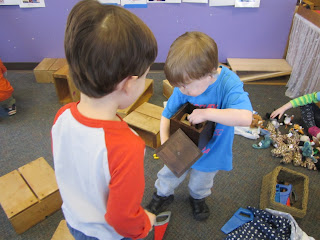
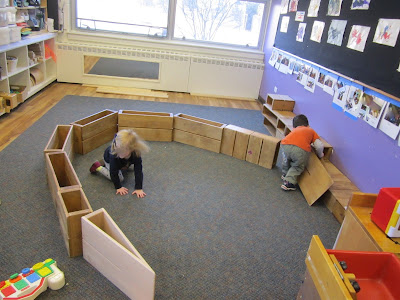
Early in the morning, two children took out the big blocks and built a large enclosure.


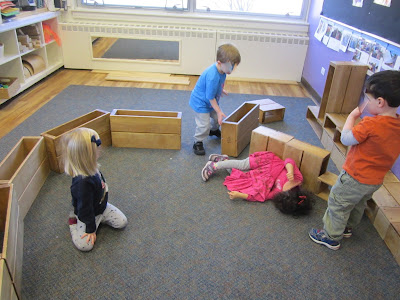
A few more children arrived, and began to take it apart.


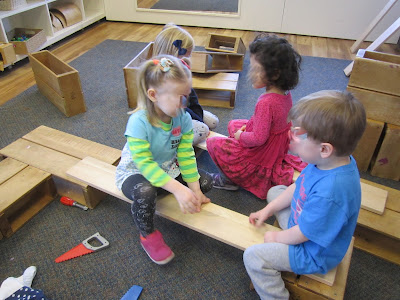
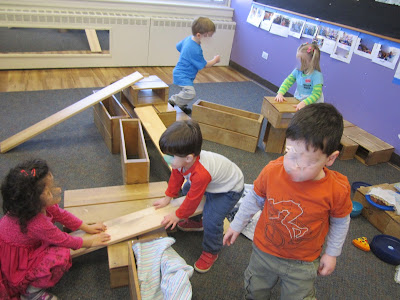
This launched a flurry of building, as the children rearranged the blocks into a new structure, and added all the remaining large blocks. Soon they discovered that the wooden planks made excellent see-saws and bridges.


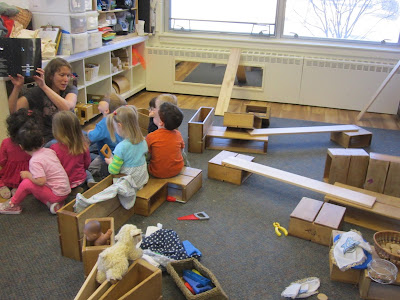
After a while, a child brought me a book and asked me to read it. The block builders were interested and came over to hear the story. Their block structures stayed where they were, ready for children to return. Some of the blocks turned into seats.


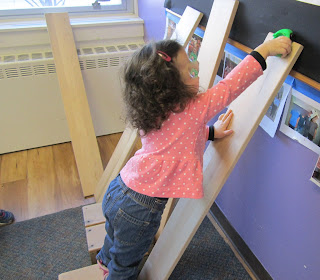
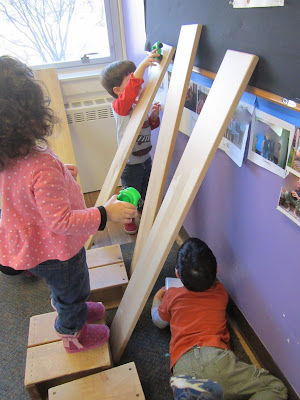
While the builders took a story break, the block area quieted down. A child who had avoided the large group commotion earlier in the morning came over to explore using the large planks as ramps. Soon, some of the original builders returned and joined her.


The block building projects was mostly over as the children moved to other areas of the room, or brought other materials to the rug. Some of the children stayed by the blocks, using them as seats or walking from block to block. One child filled a box with small toys that other children had left on the rug and walked between the blocks, handing them out.


Soon, the morning playtime was over, and it was time to clean up and put away the toys. The children and teachers worked together, putting toys back into baskets and stacking the blocks against the wall all ready to play another day.


Saturday, December 29, 2018

Recipes and Experiments in Intentional Teaching

Over the past few weeks I’ve been baking a lot of cookies. I’ve been adjusting recipes, trying to figure out how little changes in the ingredients can change the texture or taste? How much brown sugar or white sugar? What can I use instead of flour to make the recipe gluten free? Does it make a difference whether I use baking soda or baking powder?


None of this was random experimentation. Knowing what ingredients can be substituted, how a recipe can be “tweaked” stems from an underlying understanding of how to bake. Using brown sugar instead of white sugar is one thing, using salt instead of sugar would be something else entirely. I know that I can’t simply leave out the flour, or the eggs, I have to replace them with something else that has similar properties. Baking isn’t just a random combination of trial and error, it’s a science that’s based on knowing what and how different materials interact when combined and heated.


A few weeks ago I wrote about play and learning – that children learn through play, but just because they’re playing, doesn’t automatically mean that they’re learning. Simply having an experience doesn’t mean that learning, development, or growth will automatically follow. 


 It’s the content of that play experience – the materials that children use, the investigations they pursue, the interactions and conversations they have – that lead to learning. That’s where teachers come in. With our knowledge and experience about how learning happens through play, we can play alongside the children, interacting with them and scaffolding their explorations. We can provide materials and present them in ways that encourage children to think “What can I do with this?” Yes, there are some times when adult interaction interferes with children’s activity or navigates it away from the child’s agenda to the adult’s. But finding that perfect point where we can both follow the child’s lead and use our own experience and expertise to co-construct with the child is the core of intentional teaching. We aren't planning what the children should do. We're planning in consideration of all the possibilities of what the children could do, and based on our knowledge of these children and of development, what they likely would do.


Teaching isn’t all that different than baking. Following a curriculum guide word for word, just like following a recipe word for word, interferes with creativity and limits innovation. But at the same time, curriculum, just like a recipe, has some scientific basic for what works and how it works. If you put in a cup of white sugar instead of brown sugar, the consistency might change a little, but you’d still have a cookie. If you put in a cup of salt instead of sugar, your cookies would taste unrecognizable. If you left out the dry ingredients all together, you’d have a puddle that wouldn’t bake into anything. Teaching follows the same principles – just like random materials from our kitchen shelves wouldn’t necessarily bake into a cookie, children’s random activities don’t necessarily lead to learning. Curriculum objectives and standards and teachers’ experiences and professional knowledge are all pieces that contribute to the interactions of intentional teaching.  Adults need to be careful not to overwhelm children with our own agendas, but we also need to be confident in our abilities and experience to be true teachers in partnership with children. That’s where the magic of learning happens - when we strike that balance between our sharing our knowledge and helping the children to build theirs.

Sunday, December 9, 2018

Learning Through Play - But All Play Isn't Learning


“Children learn through play.”

“Play is children’s work.”

 When we say “children learn through play”, we’re recognizing and acknowledging the important process that play, as a self-directed, intrinsically motivated activity has for providing opportunities for learning and development. When we say, “play is children’s work”, we’re demonstrating value for play as an essential aspect of children’s learning, and validating its role as a centerpiece in early childhood programs.


But even though children learn through play, is all play learning?


When I mentored student teachers, their lesson plan assignments always ended with a section for them to self-evaluate the activity they had planned. Often, the student teacher would simply write, “The children had fun.” I see and hear this same evaluation in online forums, in product reviews of classroom materials, and in discussions with teachers of all levels of experience. “The kids loved it!” “They had so much fun!” “They were really interested in what they were doing!”

Is fun – or interest – or enjoyment – the same thing as learning?


Play can have many purposes – some of them involve the sheer enjoyment of the activity, or the total engagement in the moment – the “flow” as referred to in psychology. Finding joy, fun, and flow in what we do are essential to who we are as human beings, and we want to provide those opportunities for children. But just because an activity was fun, doesn’t mean that learning happened.


“Learning”, by definition involves change. It involves development and growth. Children learn through play when those play experiences lead them to do something new, or think about things in a new way. It isn’t enough for children to “just play” - teachers need to provide classroom environments, materials, and interactions that encourage children to share ideas, negotiate, experiment, hypothesize, and evaluate. Teachers need to encourage children to say “What can I do with this?” and provide them scaffolding to extend their thinking and encourage them not only to play, but reflect on what they are doing. Teachers need to ask open ended questions, provide feedback, and help children think about their own thinking


Play is the starting point, not the finish line. Play can - and should - be learning, but there are many steps along the way. And many things that teachers can – and should – do to help children get there.


Sunday, March 4, 2018

The Point of Play


I spend a lot of time on online early childhood sites, reading blogs, commenting and discussing topics on Facebook groups, and scrolling through curriculum ideas on Pinterest. Over the past few years I’ve noticed a huge growing interest in things having to do with “Reggio Inspired” “Loose Parts” and “Nature Play”, which is really exciting to me as a teacher who has spent years encouraging children to come up with their own ideas, use materials the way they want and take the lead in deciding what they want to do and how they’re going to do it. At the heart of this is my core belief that children learn through play: through activities that focus on children’s process and that allow children to have control over the planning, decision making, and interactions during these activities.


But somehow, adults keep missing this.

It’s hard to be a “teacher”. I sometimes feel that title is like a heavy backpack of expectations each of us carries, never letting us forget that our “real job” is to be teaching children something. No matter how many times we say that “children learn through play” or “process is more important than product”, there’s that pesky “teacher” baggage weighing down and whispering in our ears that what we should really be doing is making sure the kids know their numbers and ABCs.


I see this over and over again in the conversations about classroom materials. The concept of using “loose parts” http://exploreinspireec.blogspot.com/2017/04/loose-parts-and-intentional-environments.html is about providing open-ended materials that can be used in many different ways, encouraging creativity, discovery, and exploration. There’s also attention to design elements, so many of these materials are truly beautiful, and their color, shape, and texture add to the overall environment of classroom space. But I’ve noticed more and more, adults getting caught up in simply having the materials to use for their own “teacher” purposes and less on letting children use them the way the children want to.


Every experience doesn’t need to involve an adult teaching an academic skill. Every time a child sits down with a pile of colored beads or blocks, they shouldn’t be expected to sort them or create patterns. Every time a child lines up a row of rocks, they shouldn’t be asked to count them. Teachers shouldn’t be focused on what the adults can make out of bottlecaps and rocks, they should be focused on creating an environment where the children will figure out what to do with them. Instead of spending time writing letters and numbers on tree circles and seashells, teachers should be embracing these materials for what they are – opportunities for children to be creative and expressive and the leaders of their own play. That’s what the materials are for – to play with. Not to find one more surface to write numbers and letters on, or to “teach” a concept or skill, but to create a space and opportunity for children to play. Play itself is the point of play.