Showing posts with label creativity. Show all posts

Sunday, December 5, 2021

Letting Play Evolve

I've heard so many comments from teachers worrying about children "making a mess", or teachers insisting that children put away one toy before taking out another. Children's play isn't divided into distinct parts. Children don't take out one toy, or one group of objects, stop playing, then put it away to begin anew with something different. Play is fluid and evolving and continues over time. Putting away materials in the middle of playtime stops the possibility of the child returning to and continuing their play, and stops opportunities for other children to extend on another's idea. Leaving the materials out for the entirety of playtime allows play to evolve and collaboration to happen.

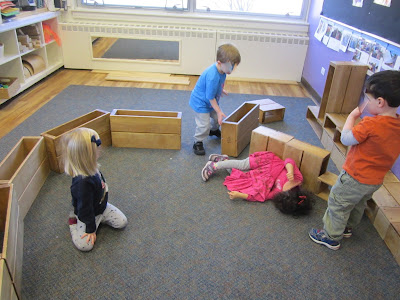
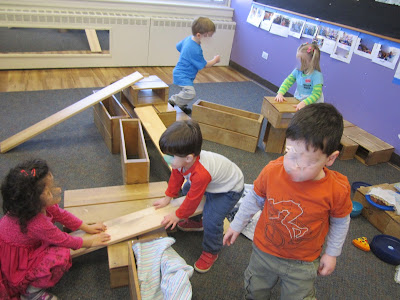
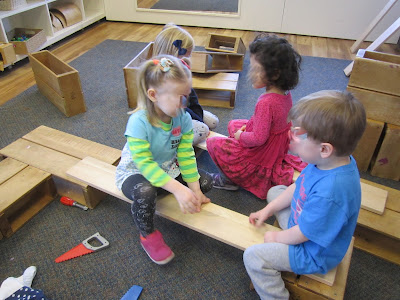
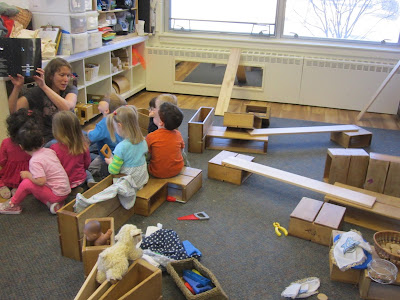
Here is a series of pre-pandemic photos from one morning in my 2-3 year old classroom:

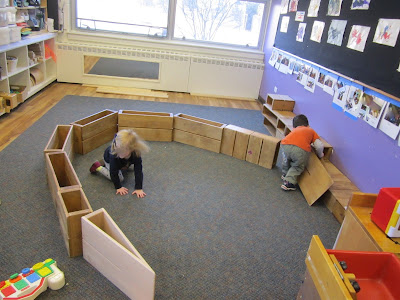
Early in the morning, two children took out the big blocks and built a large enclosure.


A few more children arrived, and began to take it apart.


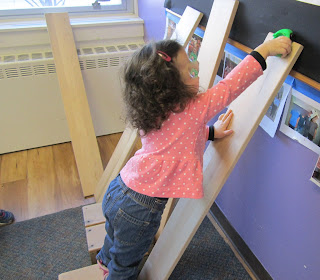
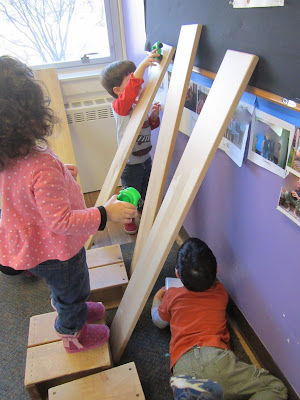
This launched a flurry of building, as the children rearranged the blocks into a new structure, and added all the remaining large blocks. Soon they discovered that the wooden planks made excellent see-saws and bridges.


After a while, a child brought me a book and asked me to read it. The block builders were interested and came over to hear the story. Their block structures stayed where they were, ready for children to return. Some of the blocks turned into seats.


While the builders took a story break, the block area quieted down. A child who had avoided the large group commotion earlier in the morning came over to explore using the large planks as ramps. Soon, some of the original builders returned and joined her.


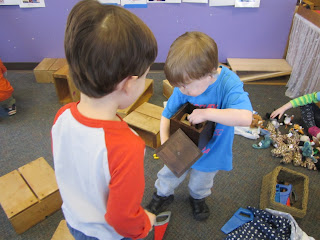
The block building projects was mostly over as the children moved to other areas of the room, or brought other materials to the rug. Some of the children stayed by the blocks, using them as seats or walking from block to block. One child filled a box with small toys that other children had left on the rug and walked between the blocks, handing them out.


Soon, the morning playtime was over, and it was time to clean up and put away the toys. The children and teachers worked together, putting toys back into baskets and stacking the blocks against the wall all ready to play another day.


Sunday, June 23, 2019

Helping Them to Put Ideas Into Action


A frequent topic on discussion boards is for someone to post a picture of an interesting loose part or material they’ve found and say, “What should I do with this?” There are always some people who respond with craft ideas - that the adult should take the wood circle or rock or cork and paint letters, numbers, faces, or attach objects together in a way that the adult is using the materials to create a toy for the child. Then there are always others who respond that that the adult shouldn’t do anything and “Just put it out and see what the children do.”

Intentional teaching and scaffolding creativity are somewhere between those two points.


Wooden circles with letters written on them aren’t as open ended as plain wooden circles. Writing a letter, or number, or design on a piece of wood or a rock changes that object into something more specific. Objects painted with faces and costumes are dolls, just like any factory made doll that could be ordered from a catalog. There’s still plenty of ways that these materials can be used creatively,  constructively, and interestingly, in classrooms - but as soon as the adult permanently makes the material into something else, some of the open ended possibilities disappear.


 At the other end of discussion, “just put it out” doesn’t give children the tools they need to do “something” with the material. Children - and adults - view objects in context, and form ideas or action not based on the object alone, but on the other objects and materials in the environment. Even the classic open ended activity of using a stick to make designs in the dirt or sand requires both a stick and dirt or sand. Banging a spoon on a pot requires a spoon and a pot. Give a baby just a spoon, or just a pot, without the other object, and their play will be very different. If we want to spark and provoke innovative and creative play, when we choose materials and objects to share with children, we need to consider “What could they do with this” and structure the environment in ways that allow children to figure out ways to use the materials together, and to have the tools that they need to accomplish their ideas.


We humans respond to objects by their context. If you’re served a bowl of liquid with spoon, you’d probably assume it’s soup. If that same liquid was served in a glass, you’d assume it’s a beverage. If that same liquid were poured in a tray with a brush, next to a piece of paper, you might think of painting with it. If it were in a pitcher, you might think of pouring it. The same process of examining contextual cues is what guides children’s planning and decision process. If I see a container with a spout, I think of pouring. If I see a ramp, I think of rolling. If I see a tube, I think of what could go inside. More important, is what I don’t see, because if the materials I need aren’t in my environment, I can’t put my ideas into action. We’ve all seen children struggling to gather pebbles or shells when they don’t have pockets, and as adults we’ve usually stepped in to find some container. The goal shouldn’t only be for children to figure out what to do on their own. The goal should be for us to be partners with them in their discovery. Our job is to listen, observe, and when needed and welcomed, to help. 


Tuesday, May 7, 2019

When Talking Gets in the Way


It’s sometimes hard to know when to talk to a child who is deeply engaged in an activity, and it’s hard to know what to say. We’ve been trained as teachers to ask questions, comment, narrate, and reflect. There are times when the right question at the right time can extend a child’s thinking and provide the spark for the next phase of their activity.

There are other times when talking just gets in the way of what they’re doing.

Even as we say that “children learn through play” and that we value “process over product” so much of teacher speech interrupts the child’s process and trying to lead the child to a tangible product. Often when a teacher says, “Tell me about what you’re doing” or “What’s your plan?”, it’s less about meeting the child where they are in the moment, and more about the teacher wanting information for themselves. Or just wanting to connect with the child who is at play, which is a wonderful goal, but requiring children who are immersed in process to answer adult questions isn’t always the best way to connect.
  
I watched while one of the three-year-olds explored wood pieces and nuts and bolts. The wood pieces had holes drilled in them, with the intention that children would discover how to fit a bolt inside, and how to connect two or more pieces with a single bolt. She worked lining up the pieces, examining the shapes they were making. She put two pieces over each other, the holes lining up almost exactly.


“I wonder what would fit inside those holes?” I asked.

She completely ignored me, and I felt a sense of discontent, that I had encroached on her process. The bolts were right there – she had been using them a moment before. If she wanted to put a bolt in the hole, she would have. She didn’t need me to tell her how to do it. Prompting her to “fit something” inside the holes was about me and my need to “teach” – not about her need to explore the materials through her own process.

Later, she put in a bolt, but didn’t push it down to connect the pieces. This time, I stayed silent, and allowed her to experience the process her way, without my interruptions.


 She added more pieces, some with bolts, some without. I wondered if she had a plan, or was just seeing how the pieces worked together as she went along. But I didn’t say anything. Just because the teacher is wondering, doesn’t mean it’s useful to the child to be asked. My wondering about her plan should not take over her process. 


Eventually, after putting together many pieces, moving them around, and taking some apart, she announced, “It’s a clock!” and showed me how two of the wooden pieces moved like hands. She added small metal pieces and said they were the numbers. After observing her entire process, I don’t think she had a “plan” to build a clock, or to build anything. For young children, the representational “product” often comes at the end of the process. After completing the process of building, or drawing, or painting, the child decides what their creation looks like, and labels it. The true learning takes place in the process, and through the play of getting there. Sometimes there are questions or comments adults have that can help them in their process, but often, we just need to get out of the way.


Tuesday, August 28, 2018

It's Not A Mess


She pulled the large blocks off the shelf, one by one, dropping them randomly into a pile on the floor.

After the first five or six blocks, I started to speak. “Now that you’ve taken some blocks out, you can start building.” She didn’t respond and continued pulling blocks off the shelf – the long double-unit blocks, making an ever bigger pile on the floor. I started to say something else – a reminder not to take out all the blocks, or an observation she didn’t look like she was building, but I didn’t.


I stopped talking and watched her work.

After taking out every long block – about twenty – and dropping them into a pile, she started to build.


First a foundation, and then walls. She first spaced out the tall blocks evenly to form columns, then filled in the space to create a solid wall.


“Look at this!” she exclaimed. She gathered up cars from a basket and lined them up inside. 


“There’s a lot of cars in there”, another child said. He counted them, pointing to each as he counted. Several other children came over to watch, and to count too.


When they were done counting, she returned to the block pile, picking up blocks to make a roof.


The finished structure bore no resemblance to the pile of randomly dumped blocks that had been on the rug fifteen minutes before. But the structure might not have existed if I hadn’t let her create that pile. As she took block after block of the shelf and dropped it in the pile, the teacher voice in the back of my head kept whispering to me to stop her. She was making a mess, not working. “Okay, you’ve taken enough blocks off the shelf, now it’s time to build”, was on the tip of my tongue.

But it’s not my decision that “it’s time to build”. It’s hers.

What looked like a mess to my teacher eyes at the beginning was her process. Her organization, and her plan. If I used my adult power to stop her process, and put my process in its place, what would I be teaching? That my ideas and my plans are more important than hers? That her concepts and problem solving aren’t valued? Or maybe, that she shouldn’t even seek solutions in the first place, because a person in power will simply direct her.

It wasn’t a mess. It was valuable work. It’s our job to learn to see the difference.


Friday, April 27, 2018

All The Blocks


“But they’ll take out all the blocks.”


Yes, they sometimes will. Sometimes they’ll take out all the big blocks, and then the little ones. And the animals, and the cars. Sometimes they’ll fit the little blocks inside of the big ones, and line up animals and cars in every empty space they see. 


That’s what the blocks are there for. That’s what all the toys are there for – for the children to use, to play with and to bring their ideas to reality.


I’ve always wondered about teachers’ hesitancy to let children play with all of something.  Teachers choose to limit children’s block play for so many reasons – concerns about safety, about activity level, about sharing. The limits are usually less about the children’s abilities than about the teacher’s feelings of control. And sometimes having all the blocks being used at once seems overwhelming to teachers, as teachers imagine every possible scenario of what could go wrong. Will the children really clean them up? How much space are they using? What happens if they get knocked down?


But instead of worrying about what could go wrong, take moment to consider what is going right.


Yes, they’ll take out all the blocks. And they’ll work together to build some amazing structures. They’ll add details and figure out mathematical relationships and engineering concepts that they can visualize years before they can explain them. They’ll create a space that is theirs. They feel a sense of ownership and pride as they develop the setting for their play, and create something that has the awesome grandness of being big and complicated. They’ll take out all the blocks, and it can be wonderful.


Thursday, December 7, 2017

Keeping "Art" in Arts and Crafts

It’s that time of year when teachers start to focus on children making things – holiday and seasonal decorations and gifts to display or to take home. Often the goal of these activities isn’t about children’s ideas or children’s experiences, it’s about requiring children to make a product that can be displayed to or given to adults. These products usually involve some template or design chosen by a teacher, with clear directions so what the children will produce will look “nice”. “I know this isn’t very process oriented, but the parents love it,” I heard a teacher say.

Is that the purpose of early childhood education, for children to follow teacher directions to make something the teacher thinks parents will “love”?

The purpose of art activities is for children to explore different materials, and experiment with their own creative expressions. What they make should be their own, not a reproduction of something a teacher was captivated by on Pinterest, or that the teacher has decided she wants children to make. We need to value children’s art as art – not as a means to create a product for adults.


One way to do this is to make a variety of art materials open and available to children daily. With toddlers and twos, it’s best to introduce one or two materials at a time, to allow them to explore their properties and give them a scaffolded experience in making choices of what to select. Children this age also need repeated experiences in figuring out how to use a material. Gluing paper seems easy to an adult, but it requires many steps that take time to figure out and practice. How do I get glue onto the paper? How much glue should I use? How do I make the thing I want to stick hold onto the paper? How many things can I stick on to this amount of glue?


Once children have had the opportunity to explore and understand basic materials like glue, paint, paper, and scissors, they’re ready for more choices. Setting up a table or art area with a small variety of materials can help them consider choices and continue to develop an understanding of the physical properties of different materials and objects.


And then when they’re ready, they can choose what materials they need, and how they’re going to use them. This is Art. They don’t need directions or templates or an example printed out from a webpage – they just need room to create.


Monday, November 20, 2017

Mindset Not Materials

This week, I gave a talk about introducing “risky play” in early childhood classrooms. I talked about the situations and reasons that first spurred me to think about risky play, I talked about some of the reasons risky play is so important to development, and I talked about some of the different play I’ve observed in my classroom, and some ways that children use materials in physically challenging ways.

What I couldn’t answer though, was how to make this happen.


How do you set up indoor and outdoor environments that encourage children to engage in risk-taking play that allows them to explore ideas of safety, control, and self-regulation? How do you choose materials for this? Most of all, how do you plan for this all to happen? The answer – I don’t know. Of course, some materials lend themselves to open ended problem solving more than others. Teachers can present materials and set up spaces that provoke the question “What can I do with that?” But once a child asks that question, it’s the teacher’s reaction that shapes what happens next.


Education catalogs are full of materials to create beautiful outdoor environments. There are countless blogs and websites with tips on how to create a “Reggio-inspired classroom.” I’ve had discussions with teachers who proudly proclaim that they’ve painted their walls beige, thrown out the plastic toys, and brought tree stumps inside for the children to sit on. All of this might be aesthetically pleasing, but there’s no automatic connection between any of these things and children’s learning and exploration. For learning and exploration to happen, the teachers need to let it happen.


Allowing children to engage in risky or challenging play involves risk on the part of the teacher. The teacher needs to trust that the children know what they’re doing, and that learning will take place. The teacher needs to trust the children’s ideas, and trust that the children are competent to discover their own questions, seek out answers, and use materials in their own creative and innovative ways – even ways the teacher didn’t expect or imagine.


Creative play is about mindset, not materials.

The most creative and thought-provoking materials will lead nowhere if teachers don’t allow them to. There’s nothing magical about a tree stump or a basket of pebbles and shells. The magic comes when children are given the freedom to test their limits – to test the limits of how high they can climb or how far they can jump, how many small pieces they can pour out and spread across the floor, how many combinations and substances they can mix, dump, and fill.


The magic is in testing the limits of innovation, and discovering ways to use materials in a new way, whether they’re sticking toys into playdough or using tempera paint to trace designs up and down their arms. And the magic is in testing out social relationships, as they discover that their words have power and meaning, and sometimes consequences, and learn to navigate the complicated world of interacting with others, some who may be friends, and some who aren’t. 

The magic is in the mindset of the teacher – the teacher who allows the children’s exploration to unfold, and knows how to guide it, not stop it. The materials mean nothing, without the mindset to let the magic happen, to trust in the children that their play will be okay, and it might even be amazing.


Sunday, July 9, 2017

Summer in the City


I teach not far from where I grew up: a city neighborhood on the north side of Chicago. When I read curriculum ideas and blogs about outdoor play, natural materials, forest schools, and the like, I always feel a slight disconnect. I love the photos of children gathering branches in the woods and building structures out of them, children sliding down a grassy hillside, children splashing by the side of a lake or pond and making mud pies on the shore. But as much as I value outdoors and natural play, those aren’t my places. I felt this way as a child, reading books about children playing in the woods behind their house, hopping across a stream on the way to school, or sledding on a nearby hill. I tried to imagine these scenes, since I knew what woods, streams, and hills were. But I couldn’t imagine them next to my house.

It’s not that I think that city children don’t have opportunities for nature play, or that I feel the difference in environment is something to feel sorry about. Growing up in the city, my friends and I played, just like children do everywhere, and during the summer, we played outdoors. We gathered grass, sticks, and leaves that we mixed into pretend soup or potions. We hunted for rocks, which were sometimes tiny pieces of crumbled asphalt or concrete, but we treasured these as much as if they had come from a beach or wooded trail. There were no trees to climb, but we played under the branches of the neatly trimmed parkway trees, and spent hours gazing up, imagining what it might be like to climb them if we could. We made hiding spaces behind the bushes that were planted neatly in front of people’s houses, or better still, the ones lining the alley behind the house, where no one would see the private clubhouse we created.


There was no stream to wade across or skip stones in. But we still played with water – water that poured from the faucet in a backyard or from a garden hose, gathered in buckets and stirred with sticks, which then became improvised paintbrushes to make designs on the sidewalk. When it rained we watched the water rushing through the gutters, and improvised dams of sticks and leaves to block the storm drain and make huge puddles to splash in.

Our games, like the games of children everywhere, revolved around the materials we had access to. We invented endless variations of hopping, jumping, and stepping games that involved leaping across sidewalk squares, or chanting rhymes as we stepped up and down the stairs on someone’s front stoop. We measured our space in sidewalk squares, distance between the alleys on each end of the blocks, the patches of grass that separated the buildings from the sidewalk, and the ones that separated the sidewalk from the street. A curb could be a balance beam, and the streetlight home base for hide-and-seek or tag.


When I reflect on my city childhood and the materials I had to play with, I’m struck by how we as teachers can get overly fixated in the materials themselves. We need to remember that the magic of outdoor play isn’t about whether there’s a stream or a tree to climb, it’s about the endless opportunities and freedom that an open-ended setting provides. It’s not that it’s crucial for a child to have a stream to splash in, or to make mud pies it’s that a child have the chance to explore whatever is in their environment. A curb can become a balance beam as easily as a log can, the key is in how the adults teach children to approach novel situations and open-ended materials, and how the adults encourage and scaffold the children’s experiences. It doesn’t matter whether the play is in a city or forest, a park or a beach, what matters is that the play happens.


Wednesday, May 10, 2017

Introducing Loose Parts - Playdough

In my last post, I talked about the challenges teachers can fact when they first start searching for ways to introduce loose parts in their classrooms. Thinking about which materials to use and how to introduce them can be overwhelming. One good starting place is to think about one material, or one classroom area, and how adding loose parts can extend and enrich the children’s play.

Playdough is a material that easily combines with loose parts. Loose parts can be stuck into playdough, playdough can be wrapped around them, or they can be used as tools to cut, stack, and connect.


One of my favorite objects to use with playdough are plastic hair curlers. The first time I used them, I expected children to use them as rolling pins. Which they did, but they also stuck them into playdough, stuffed playdough inside them, and used them as building blocks for sculptures, often with the playdough connecting the pieces.


Craft sticks, candles, pipe cleaners, or anything else that can be poked, stuck, or pushed into playdough sparks children to think about ways to make holes, experiment with balance and height, and of course, pretend to make birthday cakes, popsicles, and all sorts of food.


Small objects like beads, buttons, and counting bears can make impressions, be covered and hidden, or simply arranged in a sturdy playdough base.


Whatever the new objects, they will encourage children to think “What can I do with this?” Which is the purpose of loose parts play – giving children the opportunity to wonder, to experiment, and to approach the activity and materials with no pre-conceived notions or expectations, so that the learning is completely about the child’s ideas, and driven by the child’s process.