I've heard so many comments from teachers worrying about children "making a mess", or teachers insisting that children put away one toy before taking out another. Children's play isn't divided into distinct parts. Children don't take out one toy, or one group of objects, stop playing, then put it away to begin anew with something different. Play is fluid and evolving and continues over time. Putting away materials in the middle of playtime stops the possibility of the child returning to and continuing their play, and stops opportunities for other children to extend on another's idea. Leaving the materials out for the entirety of playtime allows play to evolve and collaboration to happen.
Here is a series of pre-pandemic photos from one morning in my 2-3 year old classroom:
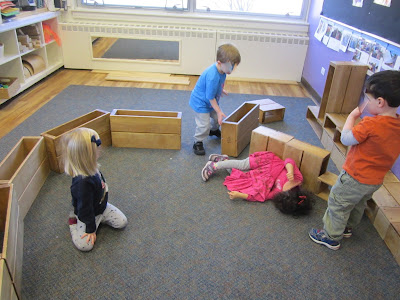
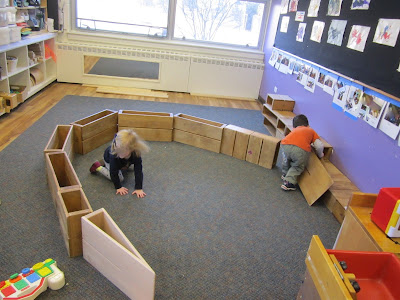
Early in the morning, two children took out the big blocks and built a large enclosure.
Showing posts with label messy play. Show all posts
Sunday, December 5, 2021
Letting Play Evolve
A few more children arrived, and began to take it apart.
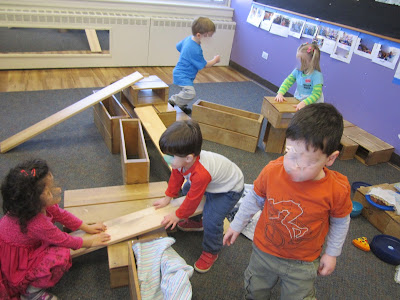
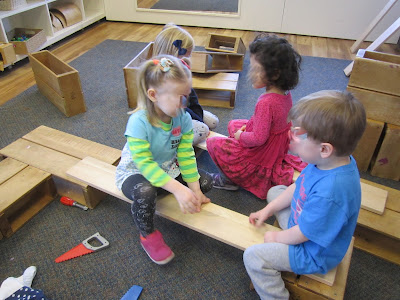
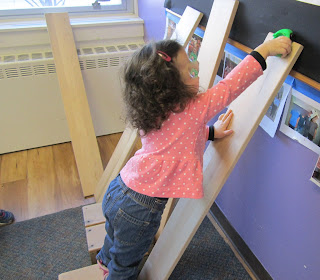
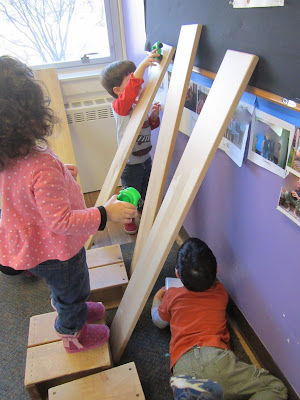
This launched a flurry of building, as the children rearranged the blocks into a new structure, and added all the remaining large blocks. Soon they discovered that the wooden planks made excellent see-saws and bridges.
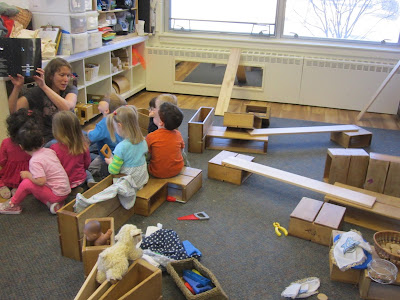
After a while, a child brought me a book and asked me to read it. The block builders were interested and came over to hear the story. Their block structures stayed where they were, ready for children to return. Some of the blocks turned into seats.
While the builders took a story break, the block area quieted down. A child who had avoided the large group commotion earlier in the morning came over to explore using the large planks as ramps. Soon, some of the original builders returned and joined her.
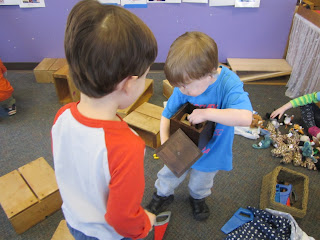
The block building projects was mostly over as the children moved to other areas of the room, or brought other materials to the rug. Some of the children stayed by the blocks, using them as seats or walking from block to block. One child filled a box with small toys that other children had left on the rug and walked between the blocks, handing them out.
Soon, the morning playtime was over, and it was time to clean up and put away the toys. The children and teachers worked together, putting toys back into baskets and stacking the blocks against the wall all ready to play another day.
Labels:
blocks,
creativity,
environment,
messy play,
play,
social play
Sunday, February 11, 2018
Frozen Paint
During winter, sensory experiences involving things
that are frozen or cold are a natural fit. When there’s snow, that can lead to days of exploration in the sensory table. And there are all sorts of other materials to freeze,
including paint.
Freezing paint is easy – just fill small paper or plastic cups with tempera paint (Biocolor brand works well - http://amzn.to/2EztcKB), put in a craft stick (large ones work best), and put in the freezer. Even better, if the outdoor temperature is below freezing, put it outdoors in a safe place, to give the children the opportunity to observe what happens as paint freezes.
When I first started using frozen paint in my classroom, I thought of it mostly as an art activity. As the children move the paint popsicles across the paper, it leaves creamy, crayon-like marks. As the paint warms, it starts to melt into a thick gooey paint.
Over time, as I introduced this activity to different groups of children, I noticed that the children’s interest in frozen paint focused more on the sensory aspects than the art ones. The most interesting feature of the paint wasn’t how it looked on paper, but what happened when it melted. I started putting the paint out on trays, not just for easier clean up, but so children could fully experience the tactile sensations of moving the goopy paint around as it melted.
The paint swirled and layered on the paper, and began to soak through, transforming paint and paper alike.
And before too long, the paint “popsicles” transformed and fell off their sticks,
melting into the familiar texture of paint, to spread on paper with sticks and
hands, or to simply enjoy the sensation and feeling of paint on fingers and hands.
“We
are a participant in the Amazon Services LLC Associates Program, an affiliate
advertising program designed to provide a means for us to earn fees by linking
to Amazon.com and affiliated sites.”
Friday, November 18, 2016
Painting With (and on) Fingers and Hands
“Paint goes on the paper.”
“Use your brush, not your hands.”
“We’re
not finger painting today.”
I’ve
heard these phrases over and over, as teachers try to guide the children to use
whatever painting tool and surface that had been provided, and not stick their
fingers into the paint. Or not trace the brush up their hands and arms, or not finish
their work by swiping their hands across and around the paper.
The
fact that each time a paint is provided, children are drawn to use their hands
and fingers means that there’s something compelling to them about using those
tools rather than a brush or whatever object the teacher had planned. If this
is how the materials are speaking to the children, and we truly believe that
art should be focused on process, not product, then why do teachers spend so
much time trying to redirect children from their innate drive to create art in
the most tactile way?
Last
week I put out the paint trays with q-tips (cotton swabs). For the younger
children, the small q-tips are easier to manipulate than large brushes. Also,
knowing that it’s likely some children will abandon the brush, or use all the
brushes at once, q-tips are more manageable for me and are easier to clean up.
The work started with children using the q-tips to make designs and blocks of color on their paper.
But
then, the exploration shifted. A finger, and then a hand, became the palette to
apply paint to.
And
then, the rainbow striped finger became the tool to apply paint to the paper.
None
of this was random. The children concentrated as they applied paint, layer by
layer, observing as the colors blended or not, noticing stripes and dots and
waves across their hands. They noticed the shades mixing together, as red and
yellow became orange and blue and green and red became black.
As they moved the
paint with precision across their hands, I wondered, why would we value the art
created on the palm of a hand any less than the art created on paper?
Why
stop the fingers dipped in paint, why send the children off to wash the
masterpiece off their hands before it’s completed? Instead, why not move into
the child’s world, and appreciate the work before us – even if it’s on a hand
instead of paper.
Saturday, August 6, 2016
To Smock or Not To Smock
This week I presented a workshop called “Planning Purposeful Play”, all about how to set up classroom environments and present materials in ways that encourage children's engagement in intentional, purposeful activities. My presentation included a slide show of different materials and play scenes from my classroom, and in both sessions, participants mentioned that they noticed that most of the children in the photos weren’t wearing smocks.
I hadn’t really thought about this until they pointed it out. I’ve worked at programs that require smocks and ones that don’t. I’ve worked with teachers who require smocks for any art or sensory activity, and ones who only require smocks for things that can wet or stain clothing. I’ve visited schools where there are no smocks at all, so whether or not to wear them isn’t even an option. In my own classroom, I’ve tended to lean toward encouraging smocks but not requiring them. So, what do I say to workshop participants who want to know my view on smocks?
It depends.
It depends on your own personal comfort level as a teacher. It depends on the policy of your school, and your relationship with parents. It depends on the culture of the classroom and of the communities you serve. It depends on the children – not everyone wants to wear a smock, and not everyone is willing to get messy.
But, since “it depends” doesn’t sound like a satisfying answer, I’m trying to
flesh out what that actually means in practice. Whether or not to
require/encourage/provide smocks is as important a planning decision as how to
choose materials or how to set up an area of the room. Here are some things I
consider when making the smock decision:
1) What are the
expectations of the parents? In most schools where I’ve taught, parents are
told that their children will get messy and stained, and to send them in clothes
that can get dirty. However, not all parents are comfortable with this. Schedule
and transportation routines after school, access to laundry facilities, and
personal preference all play a role in parents’ attitudes. I wouldn’t say that
all children must wear smocks just in case some parents don’t want mess, but if
a parent requests I put a smock on their child, I will try to.
2) What is the child’s comfort level of wearing/not wearing a smock? One of my basic beliefs in planning is to set up an environment where children can be successful doing the play based learning that I want them to do. A child who doesn’t want to get wet or messy might feel more comfortable wearing a smock. A child who doesn’t want to wear a smock might avoid wet or messy activities to avoid wearing a smock. In the end, my goal is for the child to be able to play where they want to – if a smock is helping them or keeping them from playing, I’m going to make the decision that best helps the child engage in play.
3) How messy is
the activity? Looking at my photos, I saw the children were wearing smocks
while playing with shaving cream and tempera painting, but weren’t while playing
with water, sand, or watercolor paints. If a material is likely to get all over
clothing, I’m more likely to encourage smocks. And if a material is more likely
to stain, I’m more likely to encourage smocks. Wet clothes will dry, painted
clothes will need to be washed. But still, if having to wear a smock means a
child will refuse to paint, I’d rather see the child painting.
4) Can they wear the smocks comfortably and do the activity? Do smocks impact classroom management issues? I realized I’m less likely to require twos to wear smocks than older preschoolers. It’s very hard to find smocks small enough to fit toddlers and twos, and many of those small smocks are designed in ways the younger children find uncomfortable or hard to put on – they have sleeves or snap closures, or other features they can’t do by themselves. Which creates a classroom management issue. If they can’t put them on or take them off by themselves, a teacher needs to help. Or, if they do take them off themselves, whatever paint is on the smock is likely to get all over their clothes anyway.
That last statement is probably the biggest reason I don’t worry much about smocks, because no matter what I do, the paint or water will get on their clothes anyway. We’ve all seen kids reach under their smocks to wipe their hands on their clothes, or pour a bucket of water on their pants and shoes. We can do the best we can, and we can tell the parents we’re doing the best we can, but in the end, play can be messy. Smocks or no smocks.
Subscribe to:
Comments (Atom)