I've heard so many comments from teachers worrying about children "making a mess", or teachers insisting that children put away one toy before taking out another. Children's play isn't divided into distinct parts. Children don't take out one toy, or one group of objects, stop playing, then put it away to begin anew with something different. Play is fluid and evolving and continues over time. Putting away materials in the middle of playtime stops the possibility of the child returning to and continuing their play, and stops opportunities for other children to extend on another's idea. Leaving the materials out for the entirety of playtime allows play to evolve and collaboration to happen.
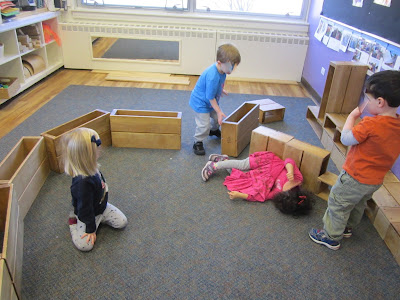
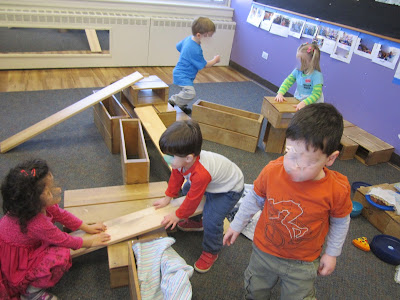
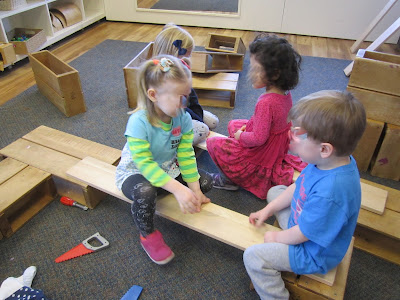
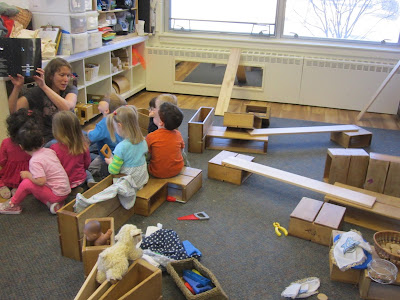
Here is a series of pre-pandemic photos from one morning in my 2-3 year old classroom:
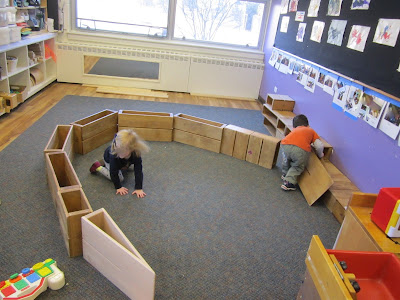
Early in the morning, two children took out the big blocks and built a large enclosure.
Showing posts with label blocks. Show all posts
Sunday, December 5, 2021
Letting Play Evolve
A few more children arrived, and began to take it apart.
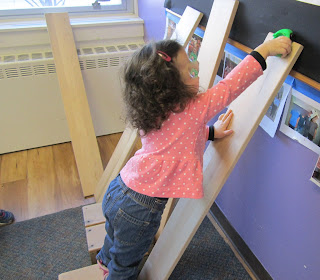
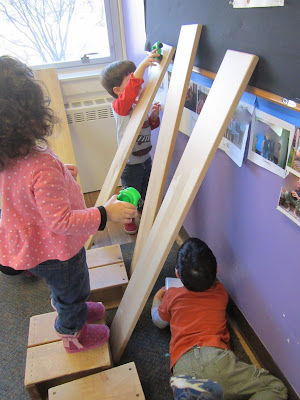
This launched a flurry of building, as the children rearranged the blocks into a new structure, and added all the remaining large blocks. Soon they discovered that the wooden planks made excellent see-saws and bridges.
After a while, a child brought me a book and asked me to read it. The block builders were interested and came over to hear the story. Their block structures stayed where they were, ready for children to return. Some of the blocks turned into seats.
While the builders took a story break, the block area quieted down. A child who had avoided the large group commotion earlier in the morning came over to explore using the large planks as ramps. Soon, some of the original builders returned and joined her.
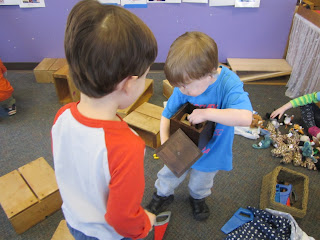
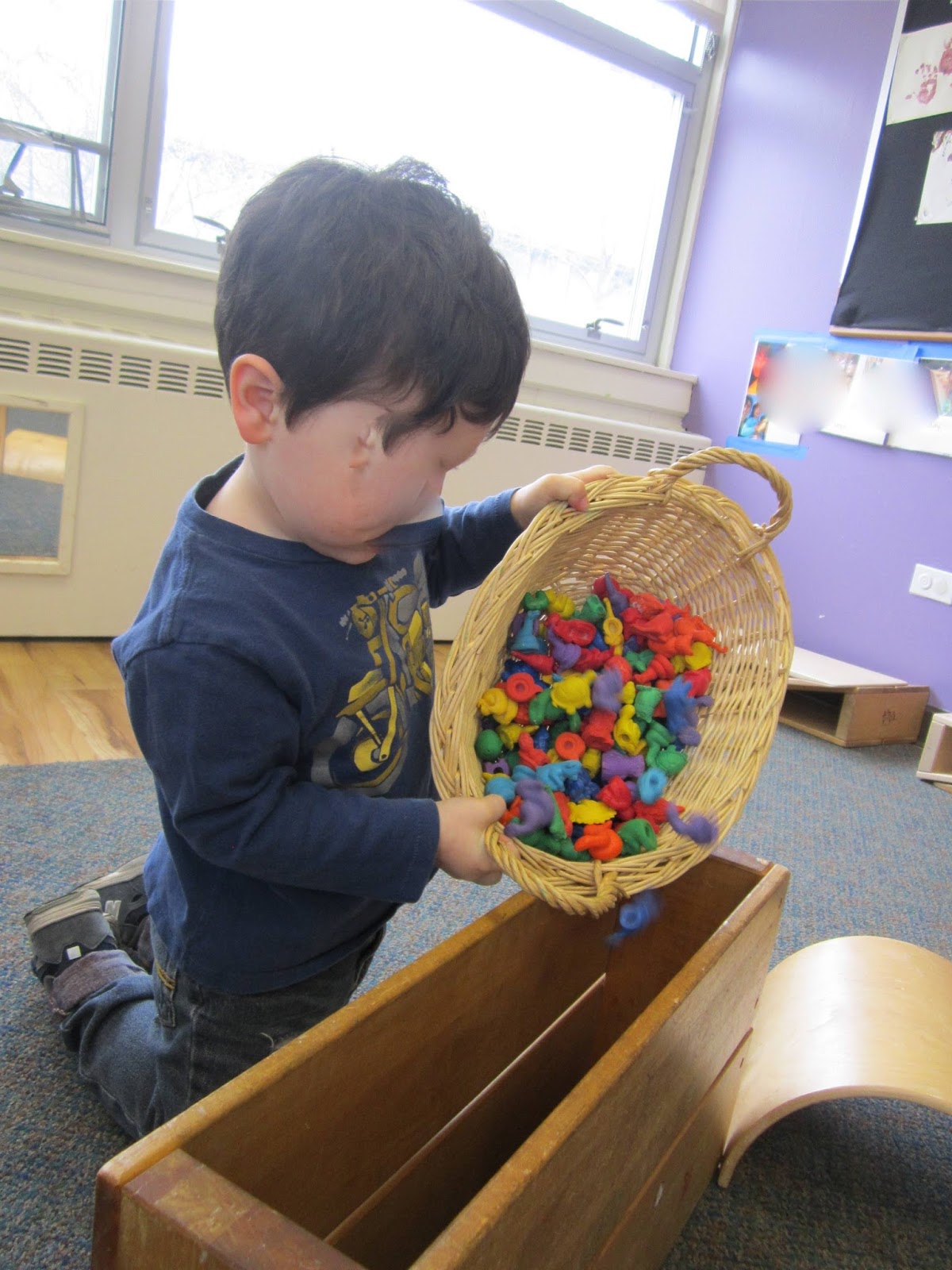
The block building projects was mostly over as the children moved to other areas of the room, or brought other materials to the rug. Some of the children stayed by the blocks, using them as seats or walking from block to block. One child filled a box with small toys that other children had left on the rug and walked between the blocks, handing them out.
Soon, the morning playtime was over, and it was time to clean up and put away the toys. The children and teachers worked together, putting toys back into baskets and stacking the blocks against the wall all ready to play another day.
Labels:
blocks,
creativity,
environment,
messy play,
play,
social play
Tuesday, August 28, 2018
It's Not A Mess
She pulled
the large blocks off the shelf, one by one, dropping them randomly into a pile
on the floor.
After the first five or six blocks, I started to speak. “Now that you’ve taken some blocks out, you can start building.” She didn’t respond and continued pulling blocks off the shelf – the long double-unit blocks, making an ever bigger pile on the floor. I started to say something else – a reminder not to take out all the blocks, or an observation she didn’t look like she was building, but I didn’t.
I stopped talking and watched her work.
After taking out every long block – about twenty – and dropping them into a pile, she started to build.
First a foundation, and then walls. She first spaced out the tall blocks evenly to form columns, then filled in the space to create a solid wall.
“Look
at this!” she exclaimed. She gathered up cars from a basket and lined them up
inside.
“There’s a lot of cars in there”, another child said. He counted them, pointing to each as he counted. Several other children came over to watch, and to count too.
When
they were done counting, she returned to the block pile, picking up blocks to
make a roof.
The finished structure bore no resemblance to the pile of randomly dumped blocks that had been on the rug fifteen minutes before. But the structure might not have existed if I hadn’t let her create that pile. As she took block after block of the shelf and dropped it in the pile, the teacher voice in the back of my head kept whispering to me to stop her. She was making a mess, not working. “Okay, you’ve taken enough blocks off the shelf, now it’s time to build”, was on the tip of my tongue.
But
it’s not my decision that “it’s time to build”. It’s hers.
What looked like a mess to my teacher eyes at the beginning was her process. Her organization, and her plan. If I used my adult power to stop her process, and put my process in its place, what would I be teaching? That my ideas and my plans are more important than hers? That her concepts and problem solving aren’t valued? Or maybe, that she shouldn’t even seek solutions in the first place, because a person in power will simply direct her.
It wasn’t a mess. It was valuable work. It’s our job to learn to see the difference.
What looked like a mess to my teacher eyes at the beginning was her process. Her organization, and her plan. If I used my adult power to stop her process, and put my process in its place, what would I be teaching? That my ideas and my plans are more important than hers? That her concepts and problem solving aren’t valued? Or maybe, that she shouldn’t even seek solutions in the first place, because a person in power will simply direct her.
It wasn’t a mess. It was valuable work. It’s our job to learn to see the difference.
Labels:
blocks,
competent children,
creativity,
purposeful play,
teacher role
Friday, April 27, 2018
All The Blocks
“But
they’ll take out all the blocks.”
Yes, they sometimes will. Sometimes they’ll take out all the big blocks, and then the little ones. And the animals, and the cars. Sometimes they’ll fit the little blocks inside of the big ones, and line up animals and cars in every empty space they see.
That’s what the blocks are there for. That’s what all the
toys are there for – for the children to use, to play with and to bring their
ideas to reality.
I’ve always wondered about teachers’ hesitancy to let children play with all of something. Teachers choose to limit children’s block play for so many reasons – concerns about safety, about activity level, about sharing. The limits are usually less about the children’s abilities than about the teacher’s feelings of control. And sometimes having all the blocks being used at once seems overwhelming to teachers, as teachers imagine every possible scenario of what could go wrong. Will the children really clean them up? How much space are they using? What happens if they get knocked down?
But instead of worrying about what could go wrong, take moment to consider what is going right.
Yes, they’ll take out all the blocks. And they’ll work
together to build some amazing structures. They’ll add details and figure out
mathematical relationships and engineering concepts that they can visualize
years before they can explain them. They’ll create a space that is theirs. They feel a sense of ownership
and pride as they develop the setting for their play, and create something that has the awesome grandness of being big and complicated. They’ll take out all the blocks, and it can be
wonderful.
Labels:
blocks,
competent children,
creativity,
early math,
Reggio Emilia,
risky play,
social play
Thursday, January 11, 2018
Making Space For Blocks
Block play is messy and complicated - but it needs to be. Children need the experience of lifting, moving, stacking and arranging these heavy objects into something that they've planned and designed. They need to plan, discuss, argue and negoiate their ideas with each other. They need the freedom to carry out their ideas and enact pretend themes - including superheroes and alients. And they need to feel the power, self-fulfillment, and personal efficacy of the simple grandness of block construction - the power of building something bigger than themselves.. The same innate drive that led ancient humans to build towers of rocks and stone draws children to build - higher, wider, and bigger, to create something that in its sheer scope, suggests power and a feeling of "wow, look what I made!"
And,
this grandness takes space.
When
we make decisions about how to use the space we have, we can make a decision to
create space that will allow these block constructions to happen.
It might be a large space, big enough for several groups of children to each build their own structure.
It
might be a small space, where children are given the freedom to fill that space
with their block creation.
It might not be a particular space at all, but a flexibility on the part of the teacher to allow block building to happen wherever it is that the children find a way to make room.
And
wherever it happens, when we make space for blocks, we’ve made space for
children to express their competency, their power, their imagination, and all
of the skills and development that comes with.
Labels:
blocks,
competent children,
environment,
purposeful play,
social play
Wednesday, April 27, 2016
It's Just Playing
Even in play based programs, sometimes it feels like
the children should be doing more than “just playing.” Recently I read an
excellent post on the Happiness Is Here blog
titled “Why I Don’t Like Play Based Learning.” The author talked about how the
term “play based” is often used to describe adult led activity, instead of genuine child-led play, which she describes play as: “self chosen, enjoyable, inherently valuable, and
unstructured.” In a child focused view of "play based" the emphasis should be on the process of play, not the product.
One of the key aspects of true play based learning is
the opportunity for children to engage in social interaction and negotiation,
and to have opportunities to develop self-regulation, planning and other skills
that we often refer to as “executive functioning”. Teachers sometimes have a
hard time noticing that these skills are being used and practiced, because
their development isn’t as obvious as a discrete academic skill. It’s easy to
see a child sorting blocks by size, it’s a lot harder to see a child using
non-verbal cues to negotiate a place to sit on a block structure. And much of
what is learned through “just playing” can’t be quantified or classified. It’s
the experience and the process itself through which the learning happens.
I see this happen every day in my classroom, most
often in the “block area”, which isn’t a block area so much as an area that,
among many other things, happens to have blocks in it. The main attraction of
this space is its space – a large rug where there’s room to build with
large blocks, spread out rows or piles of loose parts, or to just move around.
The other day, one of the children carried a basket full of small plastic animals over to a large hollow block that was balanced on its side, and slowly poured the animals into it. This soon attracted a larger crowd, as children huddled around to peer into the colorful pool of animals.
“I think I can reach it”, someone said, and put their hand in to pull out just one piece. Then the next person had to try it, as they each took a turn reaching into the block and excitedly examining the animal in their grasp.
I think it needs to be higher,” one of the children
said, and another came quickly to join him in lifting a block onto the first
block. Looking at the two-story block, the builders attempted to reach in and
discovered that it was too high, so they took down the block.
Their audience remained huddled around the animal
filled block, gazing inside. Suddenly one child sat down and swung her foot
into the hollow space. “I think I fit in here,” she said. The conversation
turned to who wanted to try putting their foot into the space to see if it
would fit.
Meanwhile, around them, construction had begun.
Turning their attention away from the block that a foot could fit into, the
children who had started the structure joined in with the construction crew who
had just joined them.
Eventually, they all left their building and pushed some blocks back against
the wall. They sat on them, and stood on them, and smiled and laughed at each
other as they lay down and slid down slanted blocks to the bottom.
I wouldn’t have been able to observe their play and document skills by marking them off on a checklist. Maybe if I was pushed to describe what they
were learning I’d say something about spatial skills and cognitive reasoning.
But the real learning was in their ongoing interactions as they were “just
playing” – from reaching into the blocks and sticking their feet inside, to
sitting and relaxing while smiling and giggling. There’s no way we as teachers
can force that learning to occur. We just need to create spaces where it can
just happen.
Labels:
blocks,
environment,
problem solving,
self regulation,
social play
Wednesday, November 11, 2015
In Praise of Big Blocks
When my son was four, he loved preschool. One of his
only complaints was that he hardly ever got to play with the big blocks. His
classroom had a long wall lined with hollow blocks (aka “big blocks”) but that
area was only occasionally open for play. “What did you do at school today?” I
would ask. Sometimes he would say, “The big blocks were open today!” followed
by an excited description of what he had built. But much more often, his first
words about his day would be, “The big blocks were closed.”
Hollow blocks are a preschool classroom staple, either
in their own area, or combined with unit blocks. But often, teachers discourage
or ban their use. Teachers sometimes say that the play gets too out of control.
Or that the kids argue too much while building. Or that the themes that children
use are too violent, scary, or wild. Or that blocks aren’t safe, because they
might fall on someone. When children are allowed to play with big blocks, it’s
often with a lengthy set of limits and rules: how many children can play at a
time, restrictions on what can be built, and limits on the height or size of a
structure.
Why are teachers so scared of big blocks?
Yes, the play can get active. But, just like any other
activity, whether it gets “out of control” depends on teacher guidance, interaction,
and support. Yes, children will argue about what to build and how to build it,
but that social interaction should be a goal, not something to avoid. Negotiation
about planning, ideas, themes, and roles are crucial social skills that
children learn by doing. Eliminating settings for this negotiation might
prevent social conflict, but it also eliminates opportunities for children to practice
and improve these skills.
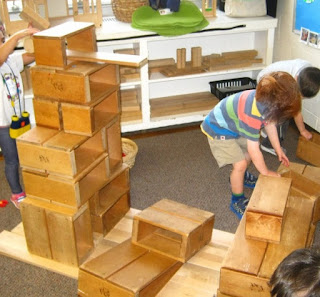
Children are drawn to the big blocks simply because
they are big blocks. It takes work to move them – challenging, physical work.
Children are drawn to the scale of the big blocks because they can make structures
that are their own size and that they can fit on, in, and under. They are
captivated by concepts of height and risk. The concern that a block could fall
on someone’s head might be expressed as fear by the teacher, but for the child,
that concern is turned into a challenge of how to prevent it from happening.
Figuring out how to build a strong, stable structure, nearly as big as or even
bigger than their own bodies, gives children a chance to express competency,
confidence, and skill. It involves imagination, creativity, engineering, and
design, all in the context of social interaction, as a group – sometimes a
large group – of children discuss, debate, argue, and negotiate about their
ideas.
Yes, the big blocks can be risky. And loud. And wild.
But they can also be imaginative, inspiring, thought-provoking, and
cooperative. They can be the place in the classroom where rich, collaborative,
social play happens. They can be the place where children propose and test
ideas and evaluate their results. They
can be the place where children learn how to disagree and discuss differences
of opinion. They can be the place where children test their limits and
abilities, and push themselves to see what they can accomplish. And we, the
teachers, can stand beside them and support them each step of the way.
Subscribe to:
Comments (Atom)