Showing posts with label schemas. Show all posts

Wednesday, June 27, 2018

Where Do You Keep Your Loose Parts?


I see lots of posts on education discussion groups asking “Where do you keep your loose parts?” Or “What does your loose parts area look like?” In my classroom, I don’t have any specific area designated for “loose parts.” Loose parts are just another type of classroom material, which children are free to use where and how they want. However, I do put some on shelves in intentional ways, with the purpose of sparking the child to think “What can I do with this?” 

I set up a small table near the door to have some interesting materials, not necessarily as a provocation to play, but an invitation to come in the door. Entering the classroom in the morning and separating from parents and caregivers can be the most stressful part of a child’s day. Having material to explore as soon as you walk in the door can ease the transition.


Loose parts provocation with napkin rings and glass beads

I also have a shelf close to the door, but not too far away from tables, with loose parts, containers, and other materials, ready for children who want to explore but might not want to be right in the midst of the play area with other children.


The materials on the shelf are set up in a way to encourage children to think about different ways to use them together. A container asks “What will fit inside?” A tray of beads calls out “Touch me and see how I feel.” 


Sometimes the children choose to play with the materials right where they are.


Sometimes they take them to tables or other areas of the room.


The magic of this space isn’t about what the children will do in this area, or even with particular objects, but what ideas will be sparked, and where they will lead.


Sunday, October 29, 2017

Purposeful Play and Loose Parts


I’ve had a lot of discussions with teachers who are enthused about introducing loose parts to their classroom, but then become frustrated that the children don’t “do” anything with them. Or, they’re frustrated with what the children decide to “do” with them – dump them all out, mix them all together, or other things that don’t match the teacher’s dream of engaged children arranging natural materials into beautiful designs.

Sometimes children dump and mix because they’re interested in dumping and mixing. Loose parts, especially small, uniform, loose parts, are an excellent sensory experience. Pouring, filling, emptying, and mixing are all natural actions for children. Younger children in particular might find pouring and filling to be more meaningful schemas than sorting and patterning. 


But sometimes children dump and mix because they don’t know what else to do with these materials. In the absence of any other cues, they turn to the familiar – dumping out containers, or mixing objects together to make soup, or ice cream, or some type of pretend food. When we’re introducing loose parts to children we need to think not only of the materials, but what we expect the children to do with the materials. We need to set up environments that encourage children to think “What can I do with this?”

Pomp poms in a basket by themselves suggest dumping. But paired with tongs and containers, they suggest lifting, grasping, and filling. Paired with trucks or dollhouses, they suggest filling, transporting, and pretending.


Containers with different size holes provide a physics experiment of what will fit through them.


Containers of different sizes, shapes, and dimensions challenge the children to explore spatial concepts and experiment with how pieces fit next to, inside, over, and under each other, as well as concepts of number, volume, length, and ratio. 


 Small containers and defined space can encourage sorting.


And, once the children start thinking “What can I do with this”, their explorations will lead the way.


Wednesday, November 30, 2016

Loose Parts and Schemas: Enclosing and Transporting

I’m always fascinated by young children’s drive to fill and empty containers, and how a simple collection of containers and things to put inside can engage children endlessly, as they fill and dump, arrange and rearrange, and carry their collections from place to place. Teachers sometimes try to label these activities in curriculum terms like “sorting” “identifying” and “classifying”, but so often, what engages the children is the simple act of combining materials together and exploring the relationship between empty spaces and objects, between containers and what can fill them.


 One way to describe this play is through schemas. Enclosure (putting objects in containers, or creating containers for objects) and transporting (moving objects from place to place) are more than simple motions. They’re the ways that children experience and create understandings about the world around them.

I watched this play develop in my two-year-old classroom recently, first as children began to scoop loose parts from large baskets into smaller cups and bowls.


First, the movement was from one basket to one bowl, but soon, they lined up rows of containers, distributing rocks, shells, and poker chips into all. They weren’t interested in sorting or counting, just moving the objects from one container to others.


 Next, they sought out containers with tops to fill just slightly or to the brim.


And carried objects to different areas, seeking out anything that could be used as a container.


I don’t know what the children’s criteria were for choosing materials, or deciding where to put them. I don’t know what connections were being formed in their heads, and I couldn’t label the specific“science” or “math” or even “problem solving” skills that would satisfy a prescribed list of early learning standards. But anyone could watch these children at play and see without a doubt that they were engaged, they were curious, and that they were processing the environment around them. This is how meaningful learning takes place.


Thursday, October 6, 2016

Planning With Verbs

On the surface, “Emergent Curriculum” sounds easy enough. Observe the children, listen to their comments and questions, and find ways to extend what they’re interested in. Emergent curriculum often takes the shape of thematic curriculum, with the notable feature that the theme is something that the children introduced, not simply something the teacher decided on. A child brings in handful of leaves collected from the playground, another child brings in leaves from her backyard, and the emergent theme becomes “Fall” or “Fall leaves.” Several children choose to play with toy construction vehicles in the block corner day after day, so the emergent theme becomes “Construction”. Teachers plan art activities and select books, plan field trips, and choose materials for every area of the classroom to support children’s interest in the emergent theme.

But how do we know that what we as teachers perceive as the children’s interest is what the actual interest is?

One of the problems I find with planning thematic units is that they focus on a topic – on a noun adults assign to the category of objects that children express interest in. Leaves, trucks, colors, doctors, bakeries, etc. etc. As adults we zoom in on the “thing” that the children are interested in, and sometimes miss the reason that they’re interested in it.


We focus our planning on nouns when we should focus our planning on verbs.

When the children gather buckets full of leaves, are they really interested in the leaves themselves – their shapes and colors, the life cycle of trees, and their symbolic significance to regional seasonal weather? Or are they mesmerized by the texture and the sound of things that crumple and crinkle? Is it even important to the children that those are leaves in their bucket, or are they seeking out any available material that they can enclose in a container and transport across the playground? The things that they are interested in are important, but equally important, and often overlooked, is what they are doing with things that they are interested in. Our planning needs to involve verbs as much as nouns.


One way to do this is to view children’s interests in terms of schemas - the ways that children interact with, conceptualize, and construct knowledge about the world. Rolling a toy truck across the rug might not be an interest in trucks, or construction workers, or building sites – it might be an interest in motion, rolling, or speed. The bucket full of leaves might just as easily be a bucket full of rocks, or pompoms, or crumpled pieces of paper, and the interest is in transporting them from place to place. It’s easy for teachers to name the objects that the child shows interest in, it’s more challenging to observe what the child is doing with those objects.


But that’s what we have to do. To facilitate truly emergent curriculum, our observations and conversations need to hone in on children’s understandings and the concepts that children are grappling with. We need to look past the theme and discover the meaning through the child’s eyes. Sometimes a pile of leaves is about the leaves, but sometimes it’s a different thing entirely.


Sunday, June 26, 2016

Playing Their Way – Geometric Shape Sorters

All of us – children, teachers, parents – have some toys we like more than others. I’m personally not a huge fan of math manipulatives that involve sorting for the sake of sorting, or fitting pieces together for the sake of fitting them together. I’m a lot more interested in manipulatives that can be used for creative building, or that can be used in a variety of ways – not the “self correcting” way where if a child doesn’t do what the toy designer planned, they can’t complete the task.

But, materials speak to everyone a variety of ways, so even if a toy isn’t one of my personal favorites, I still have it in my classroom, because one of the children might find it interesting even if I don’t. There’s also the tricky balance of selecting materials that meet the needs of all the children – ones that are challenging enough for older children but not frustrating for younger ones. One of things that’s appealing about open ended and “found” materials is that children can use them in a variety of ways, at whatever developmental level a child is at.

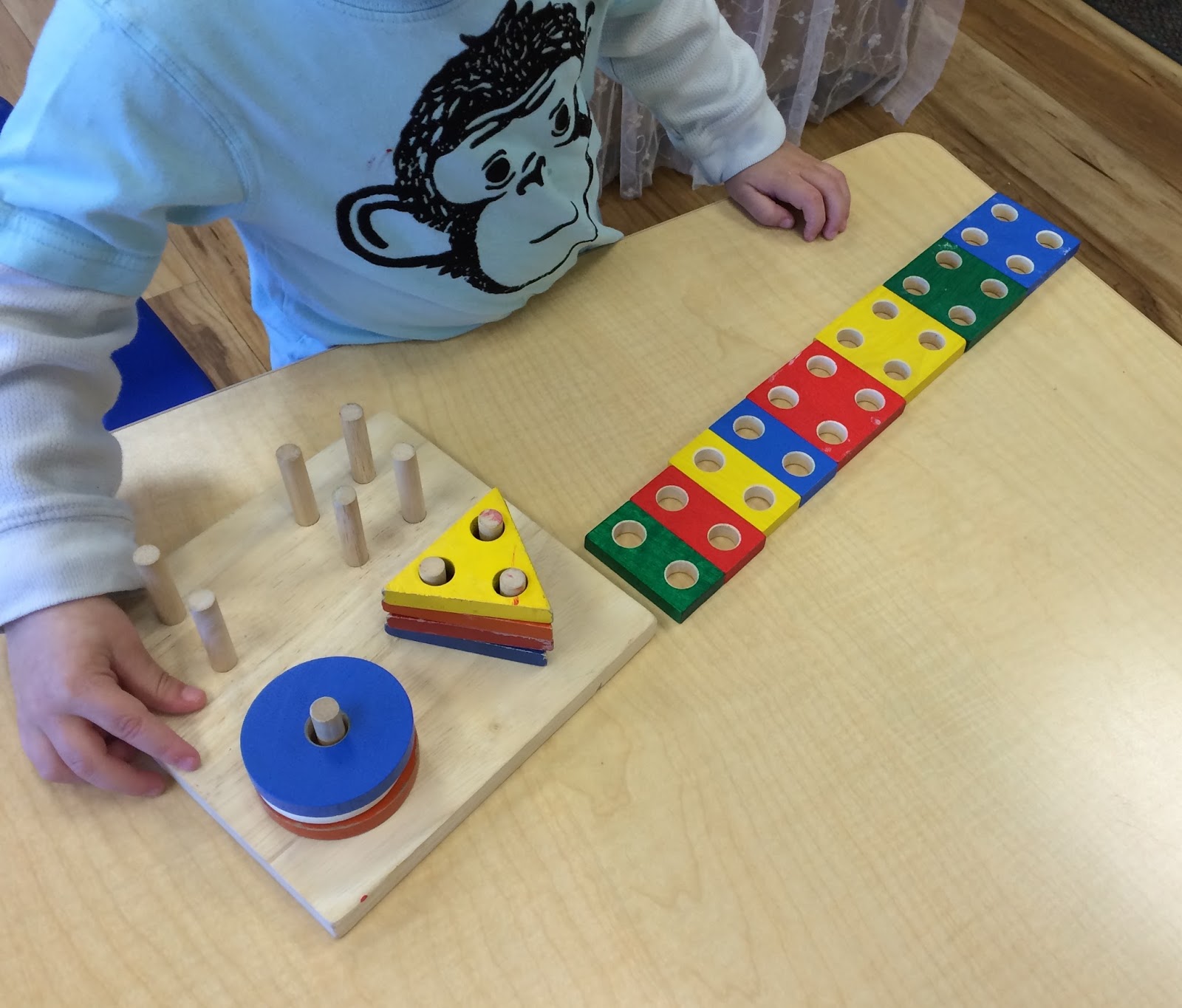
But, even if a toy seems to be close ended, giving children the freedom to explore and find novel ways to use that toy encourages innovation and problem solving. I saw this as my two-and-three year olds explored “Geometric Sorting Boards”. These are puzzle like contraptions that have multi-colored geometric tiles that fit onto pegs. Each geometric shape has a different number of holes, with the presumed goal that the children will line up the correct tile over the correct pegs. According to the manufacturer, this toy teaches “math concepts” “shape recognition” “color and pattern recognition” and “early geometry”. What I notice more often is that this toy is frustrating, because it’s hard to line the holes up over the pegs. And most preschool age children aren’t developmentally able to consider multiple characteristics of an object simultaneously – color, shape, number of holes, number of holes, and most of all, considering number of holes and number of tiles at the same time.


So, what did young preschoolers do with the geometric shape boards?


They took the shapes off the pegs. They stacked the shapes and lined them up. They carried the shapes to other parts of the room and pretended that the circles were cookies.
A few children tried to fit the shapes back on the pegs, but quickly lost interest. The pegs weren’t as interesting as the shapes themselves.


As I wrote in my last post, children will play their way with whatever we give them. We don’t need to “teach” children colors, geometry, and number – those concepts are embedded in the objects all around them. And trying to “teach” a concept they aren’t interested in isn’t going to work. Real learning takes place through self-initiation, exploration, and innovation.

Wednesday, June 22, 2016

Playing Their Way – Dollhouse Furniture

Sometimes no matter what a toy manufacturer has in mind, children find their own ways to use the toys. The way children use toys is tied to where the child is developmentally, and what schemas they’re using to explore their environment.

In my two and three year old classroom, we brought in a basket of dollhouse furniture and small wooden dolls and put them near the blocks. The children sometimes used toy animals as part of their block play, so we wondered whether they would use the dolls or furniture as well.

Two and three-year-olds generally don’t engage in pretend play where that involves acting out roles using representational objects. At this age, pretend play typically involves object substitution (pretending one object is another). And, interest in the objects themselves and exploration of their physical properties is often more engaging than pretending.

Sure enough, one of the first aspects of the furniture that the children noticed was that there were moving parts: doors and drawers that open and close.


And of course, if it’s empty inside, you have to fill it.


Some of the children used the furniture as building materials, and figured out which ones stacked and which pieces could fit inside other pieces.


One of the children did use the dolls with the furniture, but that also involved just seeing what pieces fit inside each other. And after putting a doll in or on a piece of furniture, she moved on to something else.


The one piece of furniture that evoked pretend play was the toilet, which makes sense, because using the toilet is a theme the children are very personally involved with. But they didn’t use the dolls – it was the small plastic sheep and bears that needed to “go potty”.


And of course, one of the best ways to explore a material – any material – is to line up the pieces on a shelf at eye level.


My starting point for curriculum planning is to plan based on what children might do with the toys, not on what the toys are. Children will play their way with whatever we give them. It’s our job to recognize the value of that play and build on it.