Showing posts with label self regulation. Show all posts

Monday, August 19, 2019

The First Days of School


As I’m getting my room ready for the first days of school, my first thought is, “How will the children feel when they enter my classroom?”

Starting school is a mix of emotions for children and their adults. Excitement and anticipation, and also anxiety and fear of the unknown. For children attending preschool for the first time, separation from their familiar caregiver and learning to trust a new adult to take care of them is often the only thing on the child’s (and parent’s) mind. For children who have been to school before, walking in the door of the new classroom is still a separation. They may do this better than they did the first time, but the newness of a different classroom, different teachers, and once again saying goodbye to their parents and caregivers after having some days, weeks, or even months at home brings up all the feelings of uncomfortable newness and anxiety that they experienced on their very first day of school.

Knowing that this is what’s going through their heads, my goal is to make my classroom as welcoming, comforting, familiar, and easy to be in as possible.


When children walk in the door, I want them to see a space that says, “Welcome, I’m ready for you”. I want them to see interesting things that invite them to touch, play, and explore. If I know what a child’s favorite toy or book is, that toy or book is going to be in the classroom on the first day. If I don’t, I’ll choose a variety of toys and books that over the years, have been common favorites: playdough, water or sand, paint, blocks, and cars, “The Very Hungry Caterpillar” and “Brown Bear Brown Bear What Do You See.” I’ll have multiples of popular toys, because the goal of these first days isn’t waiting, taking turns, or forcing sharing with strangers. The goal is creating an environment that tells the child, “I am here for you. I will take care of you and give you what you need.” Sharing and taking turns can come later. Building the connection and trust that I will take care of you comes first.


In those early days, especially with toddlers or children at school for the first time, the toys, books, and songs in my classroom focus on separation and the feelings that come with being at school. We’ll read about saying goodbye, about your grown-up coming back, about what it feels like to be at school for the first time. The toys in the room lend themselves to children acting out their emotions about separation, whether it’s pushing a car through a tunnel and watching it come back, or hiding an animal in a box and being able to control when that animals comes back out again. We have a predictable routine, with frequent reminders of what will happen next, and when their grown-ups will come back to get them. And most of all, I am there as a warm, safe, presence for the children. My job is to teach them that they can trust me to take care of them after their grown-ups leave, and that I can – and will – meet their needs.


Some teachers start the year will a list of expectations and procedures that they want children to get used to from the beginning. In those classrooms, the first days are endless lists of reminders, rules and procedures. Telling children what you expect them to do doesn’t build connection. But, once that connection is built – once they trust you and know that you will take care of them – then, they’re much more likely to follow the rules and expectations that you present to them. The reason I don’t emphasize rules in the first days of school isn’t because there will never be rules, it’s that at that point in time, rules aren’t what’s most important. What’s important is building relationships, establishing trust and positive connections, and creating an environment where children will follow expectations because they want to, not because their told to. Creating the place that welcomes children comes first. The rest can come later.


Friday, March 22, 2019

How Can I Teach Self-Control?


Teaching children “self-control” or “self-regulation” skills are often top on teacher’s lists. It’s often one of the most challenging group of skills, and one that teachers feel most frustrated by. Why is it so hard? Because in essence, “teaching self-control” usually means “teaching children not to express the emotions that they’re feeling.”

Of course, self-regulation is important. And of course, we all, as we mature, need to learn what feelings to share, with whom, and when. As we all know, even as adults that can be very hard. The same teacher who has an angry outburst at a staff meeting, or who shares a list of frustrations and complaints with a co-worker on her lunch break, might expect a 3-year-old child to somehow develop the skills to not get upset – or if they do get upset, not to show it, because showing it disrupts the classroom and her lesson plan.


Yes, children need to learn self-regulation skills. But, like any other skill, these skills are developmental, and adults need to be aware of what situations and emotions young children can realistically be expected to handle.


So many of the “self-regulation” issues that challenge teachers aren’t actually about children’s own self-regulation. They’re about children’s ability and willingness to comply with what adults what them to do.  There are some things that children do need to follow adult directions for, especially situations involving health and safety. But there’s also a lot of situations where adults could give children more flexibility and choice. When adults choose to demand that children follow directions and rules that come from adult perspective, or that don’t consider children’s perspectives and needs, children become frustrated. And the adults then expect the children to demonstrate the “self-control” of not expressing that frustration.


But don’t children need to learn to handle frustration?

Yes they do. But we also need to consider the reasons that they’re frustrated to begin with. When we expect children to share a limited amount of materials, or sit in the same spot for twenty minutes, or play with children who they don’t want to be with, we’re creating problems – usually without even realizing it. As adults, when we’re frustrated, we want to find solutions to the problem. We don’t want someone to just tell us to not be upset. Self-regulation is more than behaving well and not being disruptive. True self-regulation is part of a complex set of skills for managing our inner selves as we interact with the people around us. Like any other skill set, it takes time and practice to learn and develop. And that’s what the adults should expect – and should support. 


Wednesday, January 16, 2019

Making Space For Play

“It’s not your turn.”
“Stay in your own space.”
“Stop taking friend’s toys.”
“You have to share.”

So much of teacher’s time in preschool is spent policing: telling children what they can and cannot do. And a lot of that policing focuses on turn taking, sharing, and deciding who can play with what, when they can play with it, and for how long. Many of the decisions are arbitrary and exist simply because the teacher said so. Others may be rules that the children supposedly decided on together – after much prompting and guidance from the teacher to lead the children to create the rules that the teacher wanted in the first place. A common theme in classroom rules that govern sharing and turn taking is that they don’t involve children’s control or self-regulation, and rely on a teacher, wielding the power and authority of adulthood, to enforce them. 


Sometimes so much time and energy is involved in enforcing rules about sharing and turns, that it interferes with the activity itself. There’s value to social negotiation (when the children are old enough to engage in it), but when more time is spent waiting for turns or negotiating space than actually playing, I sometimes wonder if this is the best use of the child’s time, or the teacher’s time.

When there are multiple conflicts over materials and space, instead of focusing on how to force children to change their behavior, it can be helpful to re-examine your classroom environment to determine what the causes are of the conflict, and what possible solutions there might be.


1. Is there enough room?

Very often physical classroom space isn’t something we have control over. The room is too small, or is designed in a way that makes it hard to have functional classroom design. But within the space you have, how do you use it? If the block area is the most popular area of the room, is there a way to make it bigger? When you put out materials on a table, is there room for several children to play without bumping into each other? When we tell children to “stay in your own space” or “keep your hands by your own body” are we giving them the space they need so they can do this?

Animal sensory play in the water table

Individual paint trays

2. Are there enough materials? 

So many classroom conflicts, just like conflicts in the adult world, happen because there aren’t enough materials, or there aren’t enough of the specific item that multiple children always want. If you notice that day after day children are arguing over who gets to use the pink marker, you might need more pink markers. If there aren’t enough magnet tiles to build a tower, or enough sand for two children to each fill a bowl at the sensory table, then the children’s time will be spent resolving the conflict, instead of using the materials. There should be enough materials for several children to use them, and multiples of popular items (like pink markers, lego wheels, or whatever the children in your class tend to need a lot of).


3. How can you define space?

Knowing how to “stay in your own space” isn’t automatic – it’s a developmental skill that takes time to learn. Creating individual spaces where a child can easily see what materials they’re using, and know that their space is protected, can help lessen conflict, especially for toddlers and young preschoolers. Putting materials on individual trays or in individual bins, and dividing up manipulatives and art supplies into individual stations can help children find the materials they need and focus on their work.


4. How can you be more flexible?

Sometimes teachers are the ones who create the problems without realizing it. When a teacher decides that only four children can play at the playdough table, or that pretend food from the house corner can’t be moved into the block area, that moves the teacher into the role of “traffic cop”, monitoring the classroom to make sure that children and materials aren’t moving out of their designated areas. And it increases conflict when following the inflexible rule becomes more important than encouraging and facilitating play. If more children want to play with playdough, is there a way to put some on another table? If one child wants to join her four friends in the house area, is there a way to be inclusive instead of leaving her out because “the rule is four people”? Can materials be used in different areas of the room based on children’s interests, to encourage the development of rich play and ideas?

Making space isn't only about physical space, it's about creating learning environments where children have the space to explore, create, and have ownership over their own spaces. Yes, there need to be rules and limits, but its the teacher's job to balance those rules and limits with what the children need to be able to play, learn, and grow.


Monday, September 4, 2017

Heavy Work

Teachers talk a lot about the value of “heavy work”. Usually those conversations are about helping children with sensory needs or ADHD, or giving children an opportunity to work off extra energy and increase their focus and attention. Framing the conversation this way misses what the true value is of “heavy work”. Children don’t need to work off “extra” energy. Children don’t have extra energy – they have energy, period. Heavy work is a target for energy, a chance for children to take risks, set goals, and see what they can accomplish, putting their greatest energy at work. There isn’t anything magical about heavy work that increases focus. It’s the act of doing a self-selected task that has intrinsic value and that poses a challenge that pushes children to pay attention, because this task is meaningful to the child.


We all seek to challenge ourselves, to push, to pull, to lift, to climb, to reach, to ascend.


For young children, these tasks are often physical, as they test out their developing muscles and coordination, and as they learn to take risks and test out the limits of their developing bodies and abilities.. How high can I reach? How high can I climb? Can I lift this? Can I push this? All these questions have another question at the core: What am I able to do? Or, Can I do things I didn’t even think were possible?


On the playground, we see children doing what is seemingly impossible – trying to pull or push a rock or tree or pole that is immovable. Or is it? Heavy work is more than just pushing something to use up energy and see if it will move. Heavy work is having the opportunity to problem solve and discover whether you can make it move. Or not.


Having the freedom to experiment with trying to move the object is cognitive heavy work, which is just as important as the physical heavy work. The innate drive to go higher, push harder, and to test limits – both our own, and those set for us, is the heavy work that we all have to do.


Tuesday, September 13, 2016

"I'm Using It!"


“I’m using it!” I don’t know how many times a day I hear this phrase – yelled, called out loudly, emphatically, repeatedly. The four year-olds sometimes run to teachers with a complaint: “But I was using it!” Some of the two-year-olds know this phrase, but more often than not, they say it without words, by clutching the desired toy as tightly as possible.

Sometimes “I’m using it” means, “Don’t take it away from me.” Sometimes it means “Leave me alone.” Sometimes it means, “I want what you have.” But too often, instead of addressing the emotional meaning of the child’s words, teachers respond to any of these situations with lectures and rituals for sharing. 

Sharing isn’t an activity that comes naturally to very young children.  Being able to share objects, materials, and physical space comes later in early childhood, when children have the cognitive skills to consider another person’s point of view. Sharing also comes from relationships. Children who feel secure that their needs will be met, their feelings will be validated, and that they can trust other children and teachers to treat them with respect
will share when they are ready. 


But even knowing this, teachers still push sharing rules on children who are not ready, not interested, and even adamantly opposed to sharing. “We all share at school.” “You can use it for two more minutes.” “Do you want to use it for two minutes or three minutes?” “We have to share with our friends.” Forcing children to share doesn’t make them more altruistic or more empathetic – it makes them feel a loss of control and increased stress about their surroundings. Imagine that you are at a meeting and the person next to you forgot their pen. They ask you to borrow your pen – but you need your pen for taking notes. How focused on the meeting can you be while wondering when you’ll get your pen back, or whether you’ll get it back in time to write down the things you need to. Imagine if at work, you were using the computer and were told, “Someone else wants to use it, you need to give it to them in two minutes” – even if you weren’t finished with your work? If we adults would feel stressed or uncomfortable in these situations, why do we expect children to feel any differently?
Instead of forcing sharing on children, we can create environments in which children feel secure that they have what they need and that their feelings are respected:

1. Provide enough materials.

A common situation that causes children to argue over materials or hesitate to share is that there aren’t enough to begin with. When there is only one of a certain toy, especially a desirable toy, conflict will often follow. Depending on the toy, the size of the group, the personalities of the children, and what other activities are available, even two might not be enough. If there’s an object that always seems to spark “sharing” discussions, consider ways to provide similar items in the classroom, and if that’s not possible, consider whether that one single item is really all that necessary to begin with.


2. Provide alternatives.

Even with the best intentions, it’s not always possible to actually provide “enough”, especially since what is “enough” changes so often based on the situation. One way to work around not having enough of a particular material is to have multiple attractive materials or activities available at the same time. Asking, “What do you want to do while you wait for a turn?”, and being able to provide suggestions (e.g. “While you’re waiting for a bike, you can go on the swings or dig in the sandbox”) can help the child focus on something other than the discomfort of waiting.

3.  Allow children to use something until they are done.

We spend so much of our time trying to “teach” children the language of turn taking by expecting them to say a number of minutes until they’ll be done, or by telling them that they have to be done in a certain number of minutes that the teacher chooses. Linking turns to “how many minutes” doesn’t make much developmental sense, since young children have a very fluid sense of time, and can’t accurately judge how much time has passed. A three-year-old answering “When will you be done?” with “Five minutes” is repeating a phrase, not making a logical assessment of time. In most cases, telling a child, “Let her know when you’re done” or “When you’re done it’s his turn” leads to the child finishing their turn even sooner. Removing the stress that there’s someone waiting in the wings to take their toy frees children up to be able to offer the toy, instead of waiting for the allotted time to be up.

4. Make time reminders visible and concrete.

If you choose to give children a specific amount of time to finish their turn, use a timer or other concrete way that they can see when their turn is over. Knowing that “when the timer goes off, it’s her turn” is easier for children to accept than an adult simply announcing, “it’s time to give her a turn.” If many children are waiting for a turn, writing their names on a list can help them feel control over the process (as adults, we like to know that our names are on a waiting list too!) The more that the children feel the turns are following a natural process, instead of being controlled by the teacher, the more willing they will be to accept the process.

5. Follow through.

Whatever method you use for taking turns, make sure that every child gets the turn that they expect or that they were promised. If you tell a child that they can paint at the easel in five minutes, but five minutes later announce it’s clean up time, that child’s needs and feelings are not being respected. It’s also important to measure time accurately. If the child has five minutes to finish their turn, then give that child the full five minutes. Even though they can’t tell time yet, children are starting to recognize the environmental and personal cues that are related to time. If we want the children to trust that their needs will be met, then we need to be sure to meet their needs.


In the end, sharing will come from respect and relationships. It will come when they are ready. Until then, we have to accept “I’m using it.”


Monday, May 16, 2016

Working Together - When They're Ready

There’s a cute humor piece titled “Toddler Rules”. “If I like it, it’s mine. If it’s in my hand, it’s mine. If it looks like mine, it’s mine.” And so on. That sums up much of toddler behavior – and the behavior of two-year-olds, and even some children three-years-old and older. Being able to share objects, materials, and physical space comes later in early childhood, when children have the cognitive skills to consider another person’s point of view. Truly cooperative or play comes even later, once children develop the cognitive, social, and verbal skills needed for engaging in reciprocal social relationships that involve negotiation and collaboration.

Since I know that it’s unlikely that twos and young threes will be able to share or take turns, I set up my classroom with multiple sets of identical items and clearly defined play areas. This is especially important for table activities where children don’t have the same ability to move away from other children, or to spread their materials over a large area without bumping into someone else. My goal is for the children to be able to be engaged with the materials without having to be protective of their space. Knowing that “this is my space, and these are my materials” can help children relax and explore.


I usually set up paint in a way so that each child has a complete set of the same colors, so they can concentrate on painting instead of passing paint back and forth or waiting for turns. It’s hard to be immersed in the creative process if every time you need a color you have to negotiate for it, especially if you’re two-years-old, and don’t have the skills to negotiate successfully.


Last week, something amazing happened. Six children all crowded around a table set up with four spots for painting. I did what I usually do, tell the children that there isn’t more space and suggest a different activity we could do together while they wait. But one of the children looked up and said, “Someone can paint with me.” Then a second child smiled and said, “Someone can paint with me too.” They each moved over and made space for another child to share their tray of paint. They took turns choosing colors, and two of the children even started painting together on the same piece of paper.


We’re nearing the end of the year, and almost all the children in the room have turned three. The two children who offered to share their paints are the oldest in the room, both three and half. When they offered their paints a younger child (who has just turned three) at the table looked concerned, and responded by grabbing her own paint, looking straight at me, and yelling, “Mine!” in no uncertain terms – which she repeated suspiciously several times as she watched the other pairs of children paint together.

Working together is a developmental step that happens when children are ready. We can force them to share materials or take turns, but true cooperation and collaboration has to come from the child, not from adult coercion. No amount of classroom rules, incentives, scolding, or platitudes of “you can’t say you can’t play” or “we all share at school” can push a child to have the cognitive ability to engage in this type of social activity. We can model, and we can look for opportunities to encourage and scaffold prosocial behavior, but just like every other developmental skill, working together will happen – when they’re ready.


Wednesday, April 27, 2016

It's Just Playing

Even in play based programs, sometimes it feels like the children should be doing more than “just playing.” Recently I read an excellent post on the Happiness Is Here blog titled “Why I Don’t Like Play Based Learning.” The author talked about how the term “play based” is often used to describe adult led activity, instead of genuine child-led play, which she describes play as: “self chosen, enjoyable, inherently valuable, and unstructured.” In a child focused view of "play based" the emphasis should be on the process of play, not the product.

One of the key aspects of true play based learning is the opportunity for children to engage in social interaction and negotiation, and to have opportunities to develop self-regulation, planning and other skills that we often refer to as “executive functioning”. Teachers sometimes have a hard time noticing that these skills are being used and practiced, because their development isn’t as obvious as a discrete academic skill. It’s easy to see a child sorting blocks by size, it’s a lot harder to see a child using non-verbal cues to negotiate a place to sit on a block structure. And much of what is learned through “just playing” can’t be quantified or classified. It’s the experience and the process itself through which the learning happens.

I see this happen every day in my classroom, most often in the “block area”, which isn’t a block area so much as an area that, among many other things, happens to have blocks in it. The main attraction of this space is its space – a large rug where there’s room to build with large blocks, spread out rows or piles of loose parts, or to just move around.

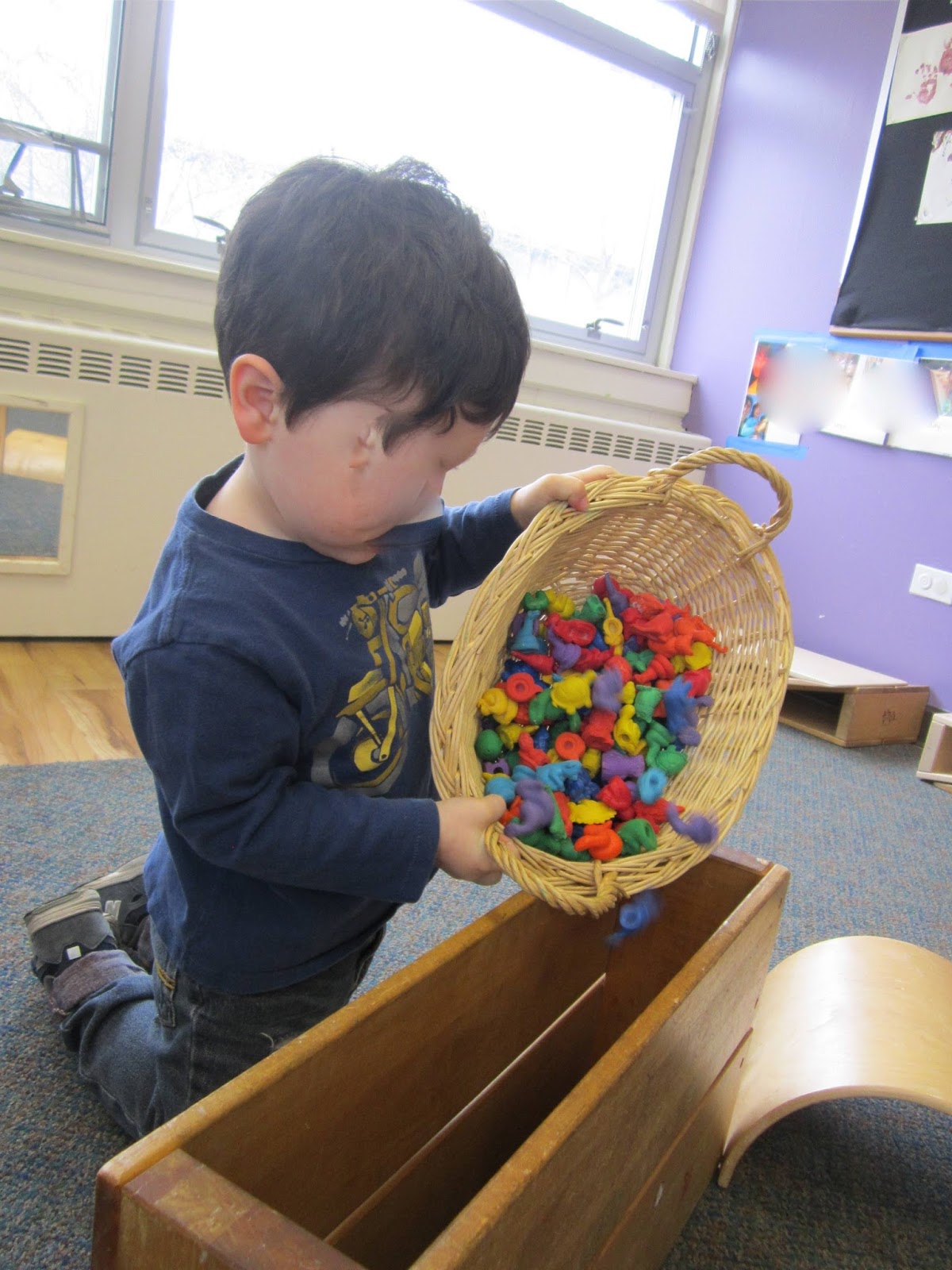
The other day, one of the children carried a basket full of small plastic animals over to a large hollow block that was balanced on its side, and slowly poured the animals into it. This soon attracted a larger crowd, as children huddled around to peer into the colorful pool of animals.


“I think I can reach it”, someone said, and put their hand in to pull out just one piece. Then the next person had to try it, as they each took a turn reaching into the block and excitedly examining the animal in their grasp.


I think it needs to be higher,” one of the children said, and another came quickly to join him in lifting a block onto the first block. Looking at the two-story block, the builders attempted to reach in and discovered that it was too high, so they took down the block.


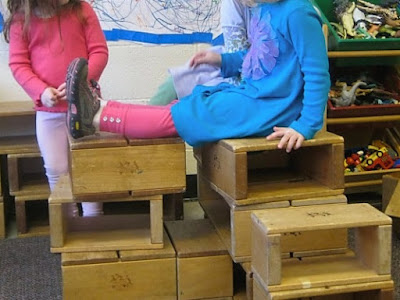
Their audience remained huddled around the animal filled block, gazing inside. Suddenly one child sat down and swung her foot into the hollow space. “I think I fit in here,” she said. The conversation turned to who wanted to try putting their foot into the space to see if it would fit.


Meanwhile, around them, construction had begun. Turning their attention away from the block that a foot could fit into, the children who had started the structure joined in with the construction crew who had just joined them.


Eventually, they all left their building and pushed some blocks back against the wall. They sat on them, and stood on them, and smiled and laughed at each other as they lay down and slid down slanted blocks to the bottom.


I wouldn’t have been able to observe their play and document skills by marking them off on a checklist. Maybe if I was pushed to describe what they were learning I’d say something about spatial skills and cognitive reasoning. But the real learning was in their ongoing interactions as they were “just playing” – from reaching into the blocks and sticking their feet inside, to sitting and relaxing while smiling and giggling. There’s no way we as teachers can force that learning to occur. We just need to create spaces where it can just happen.

Sunday, November 22, 2015

Rules and Reasons


Last week, Teacher Tom 
wrote a blog post titled “Eleven Things to Say Instead of Be Careful.” The blog was focused on the issue of “risky play”, better described by Teacher Tom as “challenging play” or “safety play”, and he suggested some more descriptive ways of explaining what we mean to children when teachers say, “Be careful.” His first example was “"That's a skinny branch. If it breaks you'll fall on the concrete."

What struck me about this statement isn’t just the clarity and honesty of it, but that a teacher was giving a child an explanation for why they should or shouldn’t do something. So often teachers tell children to do something or not do something, without giving any reason. “Be careful” falls in that category. So do so many other statements, sometimes given as a direction, sometimes worded in a way that relieves the teacher of direct responsibility, without actually giving the child the reason. “Chairs aren't for standing on.” “We wear hats when we go outside.”  “The blocks can’t be higher than your head.” All might be reasonable expectations for children, but wouldn’t they sound even more reasonable if we explained to the children why we’re saying them?

“That chair isn't sturdy enough for you to stand on.”

“I’d like you to wear your hat to keep your head warm.”

“I’m worried that if the blocks are that high, they might fall on your head and hurt you.”


Of course, when we give the children a reason for what we’re saying, we’re opening the door for them to present a counterargument, but isn’t that part of learning how to interact with others in a democratic society? Children need to understand that there are rules, but not that rules are unilaterally imposed on other people without reason. When teachers revert to “it’s the rule” or some version of “because I say so”, children might follow it, but only because of the teacher’s authority, not because of an inherent sense that it’s the right thing to do. If we want to teach children about morality, decision making, and perspective taking, we need to model democracy in our own speech. Rules don’t spontaneously exist, they’re created by people, and they can be changed by people. Perhaps that’s why teachers are so hesitant to let children into the process, because of a fear that even these very young people will try to change the rules and take some authority away from the teacher. I would argue that if the only way you can maintain authority is to remove dissent, that authority isn’t valid, even over children. If we want our children to grow up to understand fairness and reason, we need to include them in the decision making process, even if it’s only by explaining our reasoning to them.


And maybe some of our rules will need to be changed after all.


Sunday, September 6, 2015

5 Things We Say To Preschoolers

Recently I read an article called,"13 Common Sayings To Avoid". The list seemed geared to middle and high school teachers, and most of it seemed pretty obvious. I continued reading smugly until I came across one saying that I once used frequently, but that I’ve worked to eliminate from my teaching vocabulary. The phrase was well intentioned, with a clear rationale for using that particular wording, but as the years went by, I started to realize that those words might impact children’s emotional and social understandings in ways that I didn’t anticipate.

That started me thinking – what other phrases do early childhood teachers use, that, no matter how well-intentioned, might carry messages that we don’t intend?


1. “I like the way that Jenny is sitting”.

This was the phrase that caught my attention in the original article. Teachers use this phrase to call attention to desirable behavior, and it’s often seen as praising the behavior, rather than praising the child. “I like the way that you’re sitting” “I like the way that you’re cleaning up” might be motivating for the child who is performing the behavior that’s being praised, but what about the child who doesn’t hear their name? How does it feel for Amy to hear “I like the way that Jenny is ____” over and over, but not hear her own name?

Even if all the children were praised equally, this saying still focuses on praise to motivate “good” behavior, and to manipulate the other children to behave a certain way. Children shouldn’t do things to get praise from the teacher. As Alfie Kohn has written about extensively, teaching children to respond to praise is a manipulative practice that doesn’t lead to long term results.

Another way: A more emotionally honest approach is to acknowledge children with specific feedback for their behavior. “Jenny, thank you for sitting down so the people behind you can see.” “You’re being responsible by cleaning up the toys that you took out.” These phrases help children understand the effects that their behavior has on those around them, instead of reacting to praise.

2. “I need you to….”

Years ago, I was taught that I should give directions in the form “I need you to…” because this is less directive than a command. After many years of saying this, it doesn’t seem less directive at all. The words may say “I need you to pick up the blocks”, but in my position as the teacher, I’m not actually giving a choice. “I need you to” really means “I want you to” or “I expect you to” or “You have to”, and the children know that. This is another emotionally dishonest and somewhat manipulative phrase. If I say “I need you to pick up your toys”, I’m not being entirely honest, because I don’t actually “need” that. And, this is another example of manipulating children to base their behavior on what will please the teacher, instead of on what should be done out of a sense of community or shared responsibility.

Another way: Be honest and genuine when you talk about your feelings. Adults’ use of terms like “I need” and “I want” are models for children as they learn to talk about their own needs and wants. Give authentic reasons for what you’re asking children to do. “I’m going to ask you to sweep the sand that you spilled on the floor.” “We’re all having snack now, I’ll help you find a place at the table.” Linking directions with reasons for the directions help children develop a sense of responsibility and self-regulation.


3. “We’re all friends at school.”

I struggle with this one a lot – using the word “friend” when I really mean “child.” In our desire to model inclusiveness and friendship, and our fear of bullying, teachers use a lot of language referring to everyone as friends. But saying that everyone is friends diminishes the real meaning of what friendship is. And it prevents children from expressing their feelings about different people. Children can be expected to act politely or civilly to each other, to work together and cooperate, but we should not expect them to be friends with every person in the class. Also, when children say that someone isn’t their friend, there’s usually an underlying issue going on between those children that needs to be addressed, not dismissed.

Another way: Use words like “children” or “everyone” or other inclusive terms that don’t imply a specific relationship between people in the class. Respond to statements like “You’re not my friend” by trying to figure out what the underlying issue is, and help the children to work out the problem, instead of only focusing on the words they’re saying to each other.

4. “The More We Get Together the Happier We’ll Be.”

Many classrooms songs convey messages that we might not actually say to children in conversation. Like the statement about friends in #3, songs like “The More We Get Together” https://www.youtube.com/watch?v=lldmkrJXQ-E or that have lyrics like “We’re all in our places with bright shiny faces” dictate to children how they are expected to feel at school. The good intention of building classroom community by singing these welcome songs also carries the message that children aren’t allowed to have negative feelings about school, be unhappy there, or not want to be friends with the other children.

Another way: Think about the words of the songs that you use, and choose songs that have authentic messages about feelings and emotions. For example, a song that has the teacher welcoming the children, or the teacher saying “I’m so glad you’re here” sounds more honest than the teacher saying that all the children are happy to be there.


5. “You can’t say you can’t play”.

As a way to prevent bullying and exclusion, we often insist that children play with anyone who wants to play with them. As well meaning as this seems, telling children that they have to play with anyone – or let anyone join in their play – removes their choices about who they spend time with and how they spend their time. If we believe that “play is children’s work”, by dictating children’s play partners, we are interfering with their planning and decision processes about that work. As adults, most of us would resent it if a friend or co-worker insisted on telling us the solutions to crossword puzzle, or walked into our kitchen and started adding ingredients what we’re cooking. A child not allowing others to join in might just be protecting their own work space.

There’s also the issue of how controlling children’s choice of play partners teaches them about consent. When we tell children that they have to play with someone, we could be preventing them from bullying, but we’re also teaching them not to say no to bullies in the future. If we want to raise children who have the confidence to express their opinions and choices, especially when exposed to social pressure, we need to respect their choices of who to play with.

Another way: Respect children’s choices, but also model positive social interactions. Teachers can model inclusiveness by inviting children who don’t usually play with each other to join in an activity initiated by the teacher. If a child seems to be avoiding or excluding a peer, try to figure out the reason behind it, and find ways to alter the environment or materials to encourage these children to be more comfortable playing with each other.

If our goal is for children to develop social and emotional competency, and to be able to honestly express their feelings in a constructive way, then we need to provide environments that encourage children to do this. Teachers should say what we mean, and respect children’s rights to express their emotions in the classroom.

Thursday, August 13, 2015

Circle Time and Distractions


In my classroom, the schedule always includes an additional act between clean-up time and sitting down for circle time. The teachers cover the shelves of toys to indicate that the toys are put away (or “resting” or “closed”) during circle time. I’ve been doing this for years, in different age groups, and in different schools. I always thought of this as helping the children to self-regulate. If free play isn’t an available choice, then the toys shouldn’t look like they’re available. Covering them prevents the problem of having to interrupt circle time to stop a child from fiddling with a toy on a nearby shelf. I always thought of the shelf covers as a useful visual cue to remind children that “the toys are closed.”

I never stopped to wonder why I want the toys to be “closed” in the first place.

I’ve had many discussions with other teachers over the years about what is allowed behavior at and during circle time. All toys in the room must be put away, including loveys and items from home. Sometimes children must put away their hats, bracelets, barrettes. Children must sit on their bottoms and not touch the child next to them, even to hold hands. The common reason behind all of these limits is that those behaviors - holding a toy, holding a friend’s hand, fiddling with one’s bracelet or hat, are “distractions.”

Distractions from what?

Distractions from listening to the teacher. Because that is what circle time is usually about, even in play-based preschools with emergent curriculum and child-directed play throughout the rest of the day. As soon as circle time starts, the power, control, and decision making rest squarely in the teacher. What songs to sing, games to play, books to read (or, more accurately, to listen to) are the teacher’s choice. For years, circle time was when I put on my performance - reading, singing, dancing, all with children’s involvement, but with me leading the show. The children’s job at circle time was to follow my lead and do what I’ve decided they should do. I cover up the toys to hide any distractions that will keep them from doing anything but participate in the activity that I chose.

But if my activity is so engaging, why I am I worried about distractions?

Whenever we worry that something will be a distraction, we’re saying that that object, conversation, or idea will interfere in what the adults have dictated will happen next. Which often is what circle time is. The rationale for a distinct circle time that all the children are present at is usually has to do with “learning to come together as a group” or “being part of the classroom community.” But if a child would rather look at a book independently, or do a puzzle, or draw, and we compel that child to be physically present at circle time, that doesn’t build community.


There are all sorts of times for coming together in my classroom, and I’ve often found the richest are ones that weren’t scripted or planned. When I start reading a book, I usually find half the class or more coming over to hear the story. When I turn on music and start to dance, or take out musical instruments, sometimes the entire class stops building, drawing, or playing with other toys to join in. If I start to sing a rhyming song or ABC’s, I can hear voices singing along with me all over the classroom while they continue their play. If the activity is meaningful to and engaging for the children, I don’t need to compel them to participate, and I don’t need to worry about them being distracted.

If I’m worried that the children could get distracted so easily, perhaps I should consider whether what I’m doing is all that engaging in the first place.