Thursday, August 27, 2015

Seeing Competent Children


Over the past few years, I’ve been learning more about the Reggio Emilia philosophy of education. This summer, I attended an excellent two-day workshop called “Revisiting the Environment for Young Children”, which focused on creating meaningful learning environments in preschools.

One of the things that sometimes disappoints me about discussing “Reggio” with other teachers, or looking for resources online, is how quickly teachers zero in on the aesthetics of the environment and reduce the entire discussion to decorating ideas. “Where did you but those wicker baskets?” “Look at the ideas for paint storage I saw on Pinterest!” “I’m throwing out everything made of plastic and switching to wood!” But Reggio is more than decorating. A child centered, child focused, meaningful classroom environment isn’t just about beautiful baskets, natural light, and the color of the walls. It’s about the essential view that teachers hold about children.

It’s about viewing the child as competent.


Once we get past the beautiful, artistically arranged environment of Reggio-inspired classrooms, we see the messages that the environment is sending. The classroom environment is set up to support children’s choices. The baskets full of items that can be easily spilled, and easily mixed up send a message that the children are trusted to choose what they want to use, how they want to use it, and to be able to put it away again. The fragile fabrics, plants, lamps, and arrangements of natural materials send a message that children can figure out how to move through this environment without causing damage, or, that if things are broken or knocked down, the classroom community is capable of repairing them.


The arrangement of tables, chairs, and materials and the schedule of the day suggests that children are capable of managing their own time, decisions, and movement through the physical space, but also through the daily routine. I’ve so often heard teachers use phrases like “good classroom management is putting out fires before they start”. Reggio-inspired environments don’t view children as potential fire starters, or as objects to “manage”. They assume that children are competent to make decisions, and that the teacher is there to work alongside the children, not to stand above “managing” them.


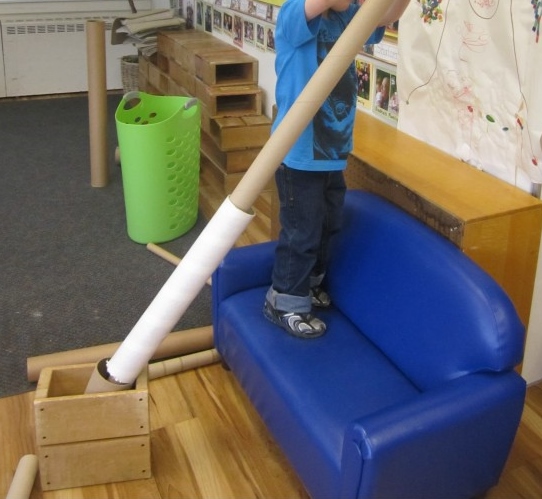
As I set up my classroom for the new school year, thinking about materials, routines, and rules, I’m well aware of the limitations of young children. But instead of focusing on the many things that young children can’t do, or that aren’t safe, or that might be frustrating to them, I’m creating an environment that supports what they can do, as competent children acting on the world around them.


Thursday, August 13, 2015

Circle Time and Distractions


In my classroom, the schedule always includes an additional act between clean-up time and sitting down for circle time. The teachers cover the shelves of toys to indicate that the toys are put away (or “resting” or “closed”) during circle time. I’ve been doing this for years, in different age groups, and in different schools. I always thought of this as helping the children to self-regulate. If free play isn’t an available choice, then the toys shouldn’t look like they’re available. Covering them prevents the problem of having to interrupt circle time to stop a child from fiddling with a toy on a nearby shelf. I always thought of the shelf covers as a useful visual cue to remind children that “the toys are closed.”

I never stopped to wonder why I want the toys to be “closed” in the first place.

I’ve had many discussions with other teachers over the years about what is allowed behavior at and during circle time. All toys in the room must be put away, including loveys and items from home. Sometimes children must put away their hats, bracelets, barrettes. Children must sit on their bottoms and not touch the child next to them, even to hold hands. The common reason behind all of these limits is that those behaviors - holding a toy, holding a friend’s hand, fiddling with one’s bracelet or hat, are “distractions.”

Distractions from what?

Distractions from listening to the teacher. Because that is what circle time is usually about, even in play-based preschools with emergent curriculum and child-directed play throughout the rest of the day. As soon as circle time starts, the power, control, and decision making rest squarely in the teacher. What songs to sing, games to play, books to read (or, more accurately, to listen to) are the teacher’s choice. For years, circle time was when I put on my performance - reading, singing, dancing, all with children’s involvement, but with me leading the show. The children’s job at circle time was to follow my lead and do what I’ve decided they should do. I cover up the toys to hide any distractions that will keep them from doing anything but participate in the activity that I chose.

But if my activity is so engaging, why I am I worried about distractions?

Whenever we worry that something will be a distraction, we’re saying that that object, conversation, or idea will interfere in what the adults have dictated will happen next. Which often is what circle time is. The rationale for a distinct circle time that all the children are present at is usually has to do with “learning to come together as a group” or “being part of the classroom community.” But if a child would rather look at a book independently, or do a puzzle, or draw, and we compel that child to be physically present at circle time, that doesn’t build community.


There are all sorts of times for coming together in my classroom, and I’ve often found the richest are ones that weren’t scripted or planned. When I start reading a book, I usually find half the class or more coming over to hear the story. When I turn on music and start to dance, or take out musical instruments, sometimes the entire class stops building, drawing, or playing with other toys to join in. If I start to sing a rhyming song or ABC’s, I can hear voices singing along with me all over the classroom while they continue their play. If the activity is meaningful to and engaging for the children, I don’t need to compel them to participate, and I don’t need to worry about them being distracted.

If I’m worried that the children could get distracted so easily, perhaps I should consider whether what I’m doing is all that engaging in the first place.


Sunday, August 9, 2015

Leaving Room For Wonder


Walking through the park one morning, I noticed a few bricks red bricks peeking up through the grass. Taking a closer look, I noticed a line of bricks. Then, further on, I saw there were actually two rows of red bricks, buried or covered by grass in some places, a brick or two missing in others, stretching through the park.

What were they once a part of?

I had never walked this way before, or at least not in a long time, and couldn’t remember having seen them before. Were they part of an old path? That seemed the most logical answer. But then why were the bricks only in lines, without anything in the middle? Could this be the remnant of some structure? I thought briefly about taking out my smart phone and googling my question – no doubt someone had already asked and answered it before. But it was a beautiful day, and I wanted to enjoy the walk, not stand in the park staring at my phone.


I decided that I’d look up the answer later – maybe there was information on the historical society website, or if not, I could post my question on a “forgotten history” or local architecture forum and get a quick answer. I continued my walk, thinking and wondering about the rows of bricks that continued in uneven and broken rows through the grass. The discovery of the unexpected started my mind wandering, and wondering. What other mysterious objects might I discover? After a while I noticed several half buried bricks in the area around a bench, and then around a tree. Eventually, I found a spot in the park where the bricks clearly formed an intersection of what must have once been paths, now abandoned. But I continued to wonder. Why had these paths been designed this way? And how did they fall into disuse? Why were the bricks so prominent in some places, yet buried in others?


What if I had been on a walk with children when I had noticed these bricks? Perhaps I might have said, “I wonder why these bricks are here?” and used their observations as some starting point for a project or exploration in the classroom. And I might have worked with them to help them discover the answer to their question, in an open-ended, child directed way that allowed the children to take ownership over their own problem solving.

But why does every problem need to be solved?

Problem solving, making observations, forming hypotheses, gathering data, and evaluating the results are important skills. Logical and scientific thinking are essential components of cognitive development and school success. But when we view every question as a vehicle for scientific discovery, or a problem to be solved, we lose a spark of our creativity and imagination. We lose the ability to wonder. “Wonder” becomes just one more step in a science experiment.


But what about wondering for its own sake? Not to generate hypotheses or to find answers. We live in a world where the answers can be at our fingertips at any moment, a world where children are taught that they can discover the answer to any question, whether through their own explorations, or through a few clicks on a screen. We need to help children hold on to some moments of wonder, some moments where children are allowed the experience of wondering for its own sake, to turn questions over and over in their minds without knowing the answer. And perhaps never knowing the answer. The drive to wonder, to think, to pretend, to imagine is as crucial a part of our cognitive make up as the drive to discover. We need to leave room to wonder.


Image by © Robert Llewellyn/Corbis

Sunday, August 2, 2015

Pegboards, Pipe Cleaners, and Emergent Curriculum


Last week I posted a photo of an activity involving pipe cleaners and pegboards. Someone asked me how I came up with the idea to set up those materials in that way. The initial inspiration came from observing the children’s activities and interests. My job was to provide the materials for them to put their ideas into action.

In my two-year-old room, we have sheer fabric pieces hanging from the back of a shelving unit, with the intention that children will use them to hide, play peek-a-boo, or just explore the color and texture of the material. I hung these fabric pieces by cutting small holes in them, stringing pipe cleaners through the holes and attaching them to the pegboard back of the shelves.


One day one of the fabric pieces came loose and fell off. Some of the children watched with interest as I worked to reattach it. They wanted to help, and I gave them pipe cleaners that they could put through the back of the shelving unit, but the depth of the shelves made that hard for them to do. Plus most of the pegboard was covered in fabric, so it was hard for them to find where the holes were. So my co-teacher and I used our observations of the children’s activity to arrange an environment where they could explore these materials.

We had some small pieces of pegboard (that we had used in the sensory table), but we needed a way to stand them up. We taped one pegboard to two large hollow blocks and placed a basket of pipe cleaners nearby. Just as we expected, the children continued the activity they had begun while trying to help me fix the curtain, stringing and pushing the pipe cleaners in and out of the holes in the pegboard. Unfortunately, the tape didn’t hold, and the board fell over. We needed a new plan.


The next day, we didn’t set the pegboard in a standing position, but left it stacked with the other blocks. One of the children tried to stand it up, and it just happened to slide right into the slot along the middle of the block, which kept it firmly in place. Probably without realizing it, she had found a solution to the problem.


Several weeks passed, and we decided to set up the pegboards again in a focal part of the room, to see if any of the children would be interested. This time, we arranged the blocks so we could slide a pegboard into the slots, just as we had observed a child do accidentally before. We placed a basket of pipe cleaners nearby. The children had also recently been exploring flashlights, so we placed those nearby as well, wondering whether children would shine those on and through the pegboards.


 The placement of the peg boards in a prominent area of the room, in a physically stable way, encouraged children to explore the materials. Not only was this activity based on the children’s emergent interests, it also involved a variety of early learning objectives: fine motor coordination, color sorting, comparison of size and length, and social interaction as the children slid the pipe cleaners back and forth to each other through the holes. Through intentional planning, we were able to plan an meaningful activity based on the children's interests.


Thursday, July 23, 2015

What Can I Do With This?


It’s that time of year again, when teachers spend hours paging through catalogs and websites, scouring stores, and brainstorming ideas for what we want in our classrooms this year. There’s something exciting about a new school year filled with new materials, and a classroom prepared and ready for the next set of children to walk through the door.

As I browse through photos, descriptions, and ads, I’m sometimes reminded of a scene from the movie “Big”, in which Tom Hanks’ character is a toy designer. At a product meeting, as the executives pass around their newest toy design based on their best research, Tom Hanks says “I don’t get it.” After hearing what the toy can do, he says, “But what’s fun about that?” That scene sums up the disconnect that often happens between the best intentioned play materials, and the reality of how children use (or don’t use them) in the classroom. I would alter Hanks’ question slightly. Instead of asking “What’s fun about that?” I’d ask, “What’s interesting about that?” or “What’s engaging about that?”

Or, if I were a child I would ask, “What can I do with this?”


The materials that children are drawn to are ones that they can do something meaningful and interesting with. What’s meaningful and interesting changes over time, as children grow to meet different developmental challenges. Filling and dumping a scoop of sand over and over might be an appropriate challenge for a toddler, but for a three or four-year-old, a table filled with sand and scoops doesn’t always call out “What can I do with this?” Children of every age seek out materials that they can transform, construct, and manipulate. As we choose materials for our classrooms, we should think about what the children will do with the materials, what problems they will discover and solve, and what this material challenges them to do.


The first time I saw a basket of wood circles, or a basket of glass beads, I didn’t see how they could be engaging to children. And perhaps, sitting there in their baskets, they weren’t all that engaging. There is nothing automatically magical about any materials, whether it’s a store bought plastic toy, recycled reusables, or natural objects. The secret is in how we present them to children, how we craft an environment that suggests not what the child should do with the materials, but prompts the child to think what could be done with the materials. Where in the room we place them, what we pair and group together, what we draw attention to.


Our goal is to create an environment that replaces “I don’t get it” with “What can I do with this?"

Thursday, July 16, 2015

Playing With The Rules

In the four-year-old room, several children were using the “hex tiles” – small colored plastic tiles that were originally part of a patterning set, but that the children use mostly as “loose parts”. They sometimes pretend the tiles are food or money, they use them to build and stack, and they often simply arrange them in colorful designs without the constraint of the patterning trays.

Today, that seemed to their activity. After they dumped the basket of tiles onto the rug, they began constructing a winding, curvy line of tiles. Then one of the children brought over a basket of rubber animals – monochromatic, brightly colored animals that were probably designed as counters or math manipulatives. As one child placed tile next to tile, another started to put one animal onto each tile.

Would she match colors? Make patterns?


She announced, “Green on yellow”, and placed a green bear on a yellow tile. Then, “Red on orange”, putting a red frog on an orange tile. “Yellow on yellow.” “Blue on pink”. While one child continued laying out the tiles, first in a line, then in a rectangle, then in an ever growing spread, the other announced the color combination she was creating as she placed each animal on a tile. Eventually, the first child stopped placing tiles and joined her partner. They alternated turns as each child said her color and placed an animal.


Looking at the array of tiles and animals, there was no pattern, no matching, in fact, it seemed like a random arrangement of pieces pushed together into a large group. But having watched the children’s process, it was clear this wasn’t random at all. Working together, two children had devised a game with rules – not the rules of color matching that a teacher would have come up with, but rules nonetheless, as they established a system of placing tiles, pairing a tile with an animal, and announcing their action out loud. And then pausing, so the other child could take her turn.


They weren’t playing a game with rules, they were playing with the rules. They were constructing a concept of what rules are, and inventing a game with very beginning, rudimentary rules. They were playing with and exploring the concept of having rules, and order, and turn taking – all within their control, as they figured out what the rules were, and how the rules worked.


Tuesday, July 7, 2015

Emotional Risk, Bruised Feelings, Resilient Kids


Lately I’ve been reading a lot about “risky play” – the idea that children need opportunities to engage in play that involves physical risks. Our collective fear of physical injury, however slight, has led parents and schools to limit or ban play that might involve physical risk (or for schools, that might involve liability suits). Recently there has been a push back against the movement to “bubble wrap” our kids, as educators, psychologists, and “free-range” parents extol the virtues of physical play that might involve scrapes and bruises.

But what about play that involves emotional risk?

Even in schools where teachers extol the virtues of climbing trees, stacking rocks, and letting children hang upside down from the monkey bars, teachers are still often vigilant about protecting kids from emotional risk. Rules like “You can’t say you can’t play” and “We use nice words at school”, intentional grouping of children to promote some friendship groups and break up others, and immediate adult intervention if a problem arises (whether it’s a block tower falling down or another child saying they don’t want to sit next to another child) create an environment where children are bubble-wrapped, cushioned, and shielded against sadness, disappointment, or anger.

We’ve confused risk with danger.

As adults, we have a responsibility to protect children from danger. We don’t leave jagged pieces of metal or broken shards of glass within reach. We put guard rails at the top of the slide, and padding under the monkey bars. We use seat belts and car seats. We have a responsibility to try to prevent serious injury, but we can’t prevent every injury. We need to learn, as teachers, parents, and caregivers, to distinguish between a puncture wound and a bruise. Bruises, scrapes, and splinters are unpleasant but non-threatening risks that are part of interacting with the physical world around us. Each bruise or scrape gives a child a chance to assess risk and develop the skill set to avoid a more potentially serious injury the next time around. And each bruise or scrape gives a child a chance to recover.

In The Blessing of a Skinned Knee, psychologist Wendy Mogel writes, “Real protection means teaching children to manage risks on their own, not shielding them from every hazard….If parents rush in to rescue them from distress, children don’t get an opportunity to learn that they can suffer and recover on their own.”

In our drive to keep children from suffering, we’ve forgotten that it’s also our responsibility to teach them how to recover. It’s our responsibility to help them learn that a bruise isn’t the same thing as a puncture.

We need to do this with emotions as well. Our vigilance to keep feelings from being hurt, to keep anyone from feeling excluded, to prevent disappointment at all costs, robs children of the important skill of learning to deal with these emotional bruises. Teachers who jump in to intervene the moment a child says “I don’t want to sit next to you”, parents who carry six different snacks so they’ll always have exactly what their child wants, are shielding their child from normal risk just as much as if they stopped their child from picking up a stick for fear of splinters. Bruised feelings, just like bruised skin, will happen. Our job as adults is to help children develop the emotional resilience to recover from the bruise and move on, and to teach them to recognize the difference between a bruise and a puncture.